
“The election in Saxony-Anhalt this weekend should alarm everyone who cares about the future of Jewish life in Germany,” the Israeli diplomat said.
By Ailin Vilches Arguello, The Algemeiner
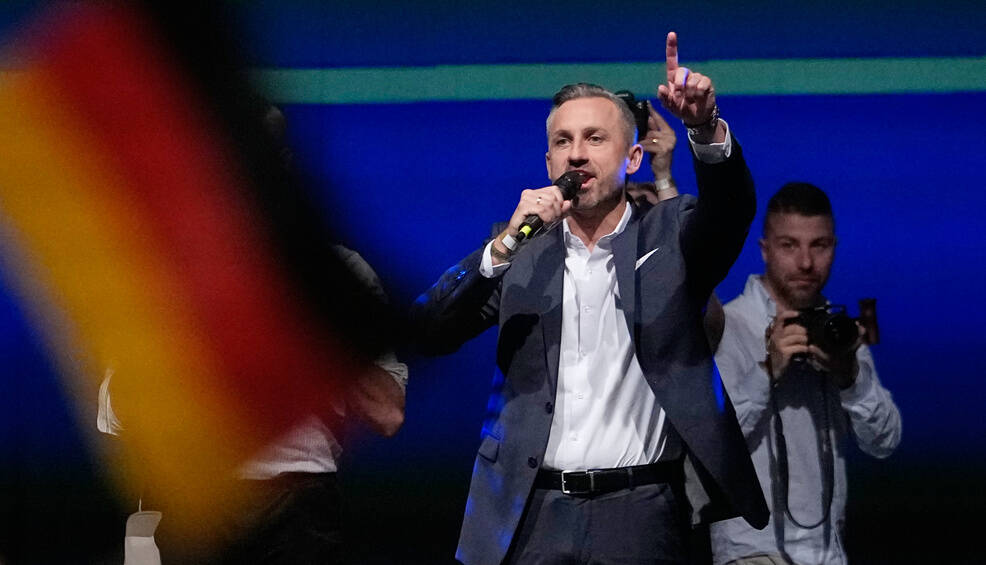
The German far-right Alternative für Deutschland (AfD) party’s historic victory in Saxony-Anhalt has sent shockwaves through the country’s Jewish community, prompting warnings from Israeli officials and political leaders who fear the party’s rising influence could threaten Jewish life and test the country’s longstanding commitment to confronting antisemitism.
The AfD — which Germany’s domestic intelligence service classifies as a right-wing extremist group — recorded its strongest-ever regional result in Sunday’s election in the eastern German state of Saxony-Anhalt.
With its historic victory, the party fell narrowly short of the majority required to establish the country’s first far-right state government since World War II.
The AfD secured 39 of the 83 seats in Saxony-Anhalt’s regional parliament, putting the party three seats below the 42-seat threshold needed to govern on its own without forming a coalition.
Even without an outright majority, the results marked a dramatic electoral breakthrough, with the party winning nearly 44 percent of the vote and roughly doubling its previous support in the state.
Josef Schuster, president of the Central Council of Jews in Germany, expressed deep alarm over the result, warning that the AfD’s rising influence could have lasting consequences for Germany’s younger generations and its efforts to preserve an open society.
“I am personally appalled by this election result,” Schuster told the German newspaper WELT. “Over the past few months, it has been clear what goals the AfD is pursuing. Anyone who voted for them today – despite or because of these goals – bears the responsibility for this result.”
“I fear the influence they will have on so many children and young people through a radically altered education policy,” he continued. “Education is the most important foundation for preserving our open society and fighting antisemitism.”
Among its campaign promises, the far-right party has pledged to recast Germany’s approach to teaching history, giving more attention to the country’s pre-World War I and pre-World War II past while scaling back lessons on the Nazi era, part of its broader call for Germans “to move beyond guilt and focus on national pride.”
Israeli Ambassador to Germany Ron Prosor also raised alarm over the AfD’s breakthrough, warning that the party’s record on hostility toward Jews poses serious concerns for the future of Jewish life in Germany, describing antisemitism as a poison that must never be tolerated.
“The election in Saxony-Anhalt this weekend should alarm everyone who cares about the future of Jewish life in Germany,” the Israeli diplomat told the Funke Media Group.
“Just 80 years after the Shoah, a party whose leaders described Berlin’s Holocaust Memorial as a ‘monument of shame’ achieved record gains,’” Prosor continued, using the Hebrew term for the Holocaust. “Germany needs a firewall against antisemitism on all fronts – not just words of condemnation, but concrete action.”
Experts warn that the AfD’s electoral gains are increasingly challenging Germany’s postwar political order, potentially putting pressure on the country’s close ties with Israel and raising concerns over the security and future of Jewish communities and institutions.
Now, Germany’s mainstream political parties face the difficult task of building a broad coalition capable of keeping the AfD out of government, as the election lays bare the deepening political divide between the country’s eastern and western regions.
Some analysts argue that Germany’s political “firewall” against the AfD may have strengthened the party rather than weakened it, allowing the AfD to remain outside government and avoid the difficult compromises and political fallout that come with governing.
At the same time, mainstream parties have struggled to deliver results through fragile coalitions, fueling voter frustration while driving more support toward the far right.
Yet others argue that the AfD’s steady advance has been driven above all by the gradual normalization of far-right ideas, rather than by the party’s exclusion from government alone.
The German party has long faced scrutiny over an extensive record of antisemitic and discriminatory rhetoric, with prominent figures repeatedly seeking to minimize Nazi-era crimes, challenging Germany’s culture of Holocaust remembrance and promoting nationalist positions that have alienated minority communities.
While a single state election cannot define Germany’s broader political landscape and may be less significant in a state that has long supported nationalist parties, far-right movements are gaining traction across Europe, raising fears among some observers of a broader nationalist wave ahead of several closely watched elections.
Sweden is set to hold legislative elections next weekend, while France faces a presidential election next spring, followed by key parliamentary contests in Italy, Spain, and Poland.
According to recent research from the political science department at the University of Amsterdam, more than 23 percent of European voters supported far-right parties in 2026, up from roughly 10 percent a decade ago and about 5 percent in 1995, representing nearly a fivefold increase since the mid-1990s.
Unlike much of Europe, modern Germany has not had a far-right or right-wing populist party lead a national government, a state government, or the administration of a major city.
Do You Love Israel? Make a Donation - Show Your Support!


Donate to vital charities that help protect Israeli citizens and inspire millions around the world to support Israel too!
Now more than ever, Israel needs your help to fight and win the war -- including on the battlefield of public opinion.
Antisemitism, anti-Israel bias and boycotts are out of control. Israel's enemies are inciting terror and violence against innocent Israelis and Jews around the world. Help us fight back!