
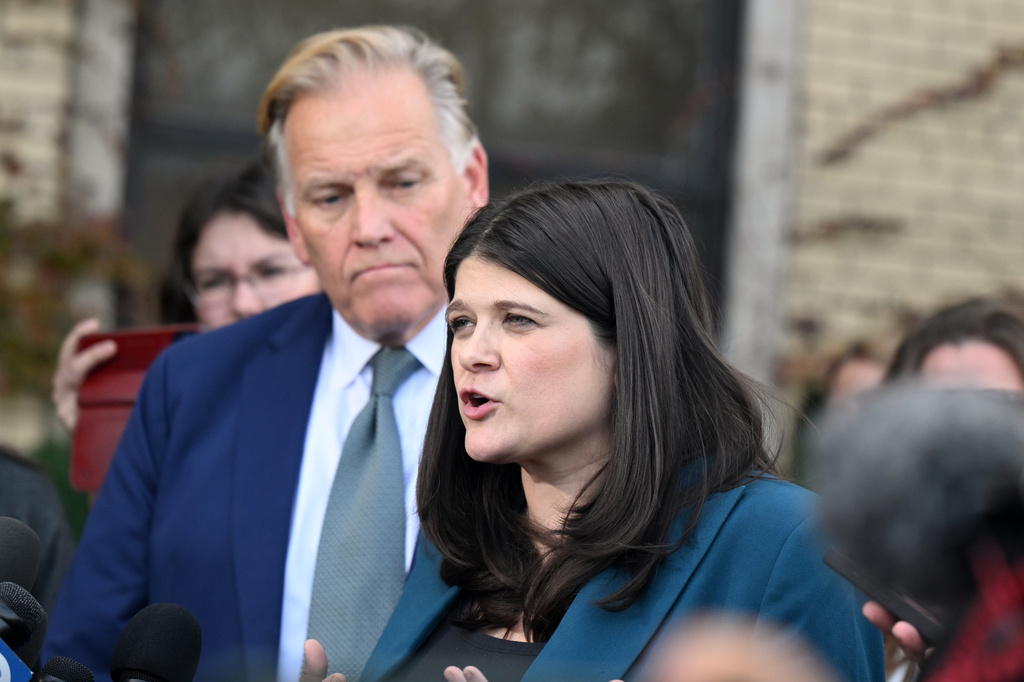
“That is sexism dressed up as political analysis. My fiancé has his own views. I have mine. I made this decision, and I am proud of it,” Stevens wrote.
By United with Israel Staff
Democratic Rep. Haley Stevens is hitting back at claims that her Jewish fiancé pressured her into endorsing Republican Mike Rogers over Democratic Senate nominee Abdul El-Sayed, calling the accusations sexist and insisting that El-Sayed’s own record on Israel drove her extraordinary decision to cross party lines.
Stevens’ stunning endorsement of Rogers in Michigan’s closely watched Senate race has sparked a furious backlash from fellow Democrats, with some critics pointing to her fiancé, Democratic donor and disability rights attorney Jason Turkish, a descendant of Holocaust survivors.
Former Michigan Gov. Jim Blanchard, a Democrat, even claimed Stevens had “snapped” and suggested Turkish had pressured her to abandon El-Sayed.
Blanchard described having dinner with Stevens and Turkish shortly before the endorsement, claiming Turkish was “working her over” about her previous decision to back El-Sayed after losing to him in the Democratic primary.
Stevens flatly rejected the suggestion that her fiancé made the decision for her.
“Think about what that says. A woman can serve in Congress, run statewide, and fight for her convictions, and still be told that when she makes a choice people dislike, someone else must be pulling the strings,” Stevens wrote Monday.
“That is sexism dressed up as political analysis. My fiancé has his own views. I have mine. I made this decision, and I am proud of it.”
Stevens’ mother, Maria Marcotte, also rejected claims that her daughter had been “brainwashed” by her future husband.
“We’re not the kind of women to be brainwashed,” Marcotte told the New York Post, calling the accusations “misogyny.”
Turkish had publicly criticized El-Sayed days earlier, accusing the Democratic candidate of making Jewish Michiganders feel “unsafe.”
“Every time he talks about genocide, Jews get death threats,” Turkish said.
But Stevens said her own concerns about El-Sayed had been building for some time, particularly over his relentless focus on Israel.
“It was obsessive, obsessive, obsessive,” Stevens told the Detroit Free Press, while also describing some of El-Sayed’s positions as “anti-American.”
Stevens lost the Democratic Senate primary to El-Sayed in August but initially endorsed him, saying she put party unity ahead of the disappointment of her defeat.
She said that changed after a series of campaign controversies involving Israel and Jewish voters.
An outside group supporting El-Sayed ran an advertisement tying rising grocery prices to American support for Israel, while El-Sayed’s own campaign featured Tucker Carlson in another ad.
“Reasonable people can disagree about Israel, Gaza, and American foreign policy,” Stevens wrote. “But blaming Israel for the price of eggs and elevating Tucker Carlson are not the way to build trust or bring people together.”
She also pointed to El-Sayed’s decision to campaign with far-left streamer Hasan Piker, whose rhetoric about Israel and Jewish Americans has repeatedly generated controversy.
“Abdul chose to campaign alongside Hasan Piker, whose rhetoric about Jewish Americans has been deeply disturbing,” Stevens wrote. “He took Piker to college campuses to tell our youth that Iran is not our enemy.”
Stevens noted that Piker recently compared efforts to win over Jewish voters in West Bloomfield to canvassing a KKK neighborhood.
El-Sayed condemned the remark, but Stevens said his decision to embrace Piker in the first place raised questions about his judgment.
“I asked Abdul to reject that rhetoric clearly,” she wrote. “I wasn’t asking him to change his platform. I was offering him an opportunity to reassure people, reject division, and demonstrate the leadership required of a United States Senator.”
Stevens said El-Sayed eventually rejected the outside advertisement, but by then she had also been told she was no longer welcome at his campaign events.
She ultimately reached a dramatic conclusion about her own party’s nominee.
“Once I concluded that Abdul El-Sayed is not fit to serve in the United States Senate, I had to confront who should,” Stevens wrote.
Her answer was Rogers, a Republican and former congressman with whom she acknowledged having significant political disagreements.
“I chose Mike Rogers, with the hope that he can serve in the tradition of John McCain: a senator willing to put country before party and stand up to his own side when conscience requires it.”
Stevens said the Democratic Party’s reaction to her decision has only deepened her concerns.
“We cannot preach inclusion while punishing dissent,” she wrote. “We cannot promise to heal a divided country if we cannot tolerate disagreement among ourselves.”
For Stevens, the controversy is no longer simply about a Democrat endorsing a Republican. She says it is about whether concerns from Jewish voters and disagreements over Israel can be raised within her party without those voicing them being pushed aside.
“Loyalty to a party should never require abandoning your values or judgment,” she wrote.
Do You Love Israel? Make a Donation - Show Your Support!


Donate to vital charities that help protect Israeli citizens and inspire millions around the world to support Israel too!
Now more than ever, Israel needs your help to fight and win the war -- including on the battlefield of public opinion.
Antisemitism, anti-Israel bias and boycotts are out of control. Israel's enemies are inciting terror and violence against innocent Israelis and Jews around the world. Help us fight back!