
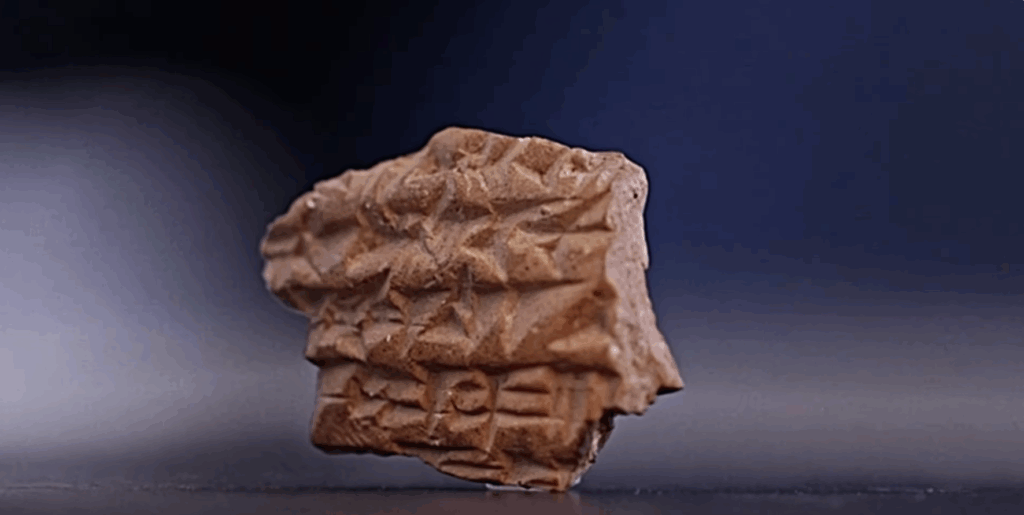
It mentions a late payment, the first day of the Hebrew month of Av, and an Assyrian court title known as ‘holder of the reins.’
By Shula Rosen
A rare Assyrian inscription discovered near Jerusalem’s Temple Mount has provided the first written evidence of direct relations between the Assyrian Empire and the Kingdom of Judah, the Israel Antiquities Authority announced Wednesday.
It also reveals the extent of Assyrian sway over Judea, given that the inscription was a tax notice issued to a king of Judah.
The find, a tiny clay fragment just over an inch wide, was inscribed in Akkadian cuneiform and dates back about 2,700 years. It mentions a late payment, the first day of the Hebrew month of Av, and an Assyrian court title known as “holder of the reins.”
Scientific tests confirmed that the clay originated in the Tigris basin—home to several major Assyrian cities—suggesting the artifact was sent from the empire’s heartland to Jerusalem.
Archaeologists believe the piece once sealed an official letter, possibly a tax notice or administrative document sent from the Assyrian king to the Judean court.
“It is probably a fragment of a royal sealing summarizing the content of the letter it secured,” Dr. Peter Zilberg of Bar-Ilan University, who helped decipher the text, told The Times of Israel. “These sealings were used for documents addressed to high-ranking individuals.”
The artifact was uncovered in soil removed from the Davidson Archaeological Park beside the Western Wall during a joint excavation by the Antiquities Authority and the City of David Foundation. Experts dated it back to the late eighth or early seventh century BCE—a period marked by Assyrian dominance and Judean tribute payments following the fall of the northern Kingdom of Israel.
Zilberg said the find likely relates to events described in II Kings, which recounts King Hezekiah’s delayed tribute to Assyrian ruler Sennacherib and the subsequent siege of Jerusalem. “It echoes the biblical story of withholding taxes from Assyria,” he said. “For the first time, we have material evidence from Jerusalem itself rather than from Assyrian archives.”
Excavation director Dr. Ayala Zilberstein said the fragment came from a First Temple-period administrative building unearthed near the city’s ancient drainage canal. “We’re uncovering a site connected to royal officials,” she noted. “This inscription confirms its political and economic importance.”
Researchers hope additional fragments will emerge as sifting continues at Emek Tzurim National Park, where material from Jerusalem’s major excavations is examined.
Bring Joy to Israeli Soldiers - Send Chanukah Gifts!


We are honored to thank the young men and women of the IDF who risk their lives every day to defend the citizens of Israel.
Join us in sending winter care packages and personal notes of support to Israeli soldiers who are out in the cold all day.
Warm up a soldier's heart with essential winter wear including fleece jackets, hats, gloves and more. Keep an entire unit warm!
THE SOLDIERS REALLY APPRECIATE YOUR LOVE AND CONCERN!
Click Here to Send Your Gift and Personal Note to Israeli Soldiers