
Netanyahu has centered his campaign on Israel’s military achievements since the Hamas-led invasion of southern Israel on Oct. 7, 2023.
By Debbie Weiss, The Algemeiner
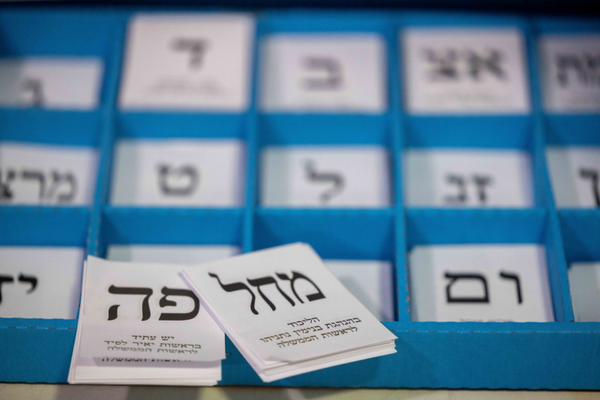
Israelis head to the polls on Tuesday for the first time since the Oct. 7, 2023, Hamas attack, in an election dominated by the wars that followed the massacre, demands for accountability over the security failures, disputes over ultra-Orthodox military service, and the rising cost of living.
The election is also a referendum on Prime Minister Benjamin Netanyahu himself, Israel’s longest-serving prime minister, who has spent a combined 19 years in office and remains on trial on corruption charges that he denies.
On Sunday, Netanyahu put Iran at the center of his final campaign push, warning that Tehran and its proxies could launch attacks to disrupt the election, hours after sharing an AI-generated image of a nuclear explosion over Tel Aviv.
The image was accompanied by a post by political commentator Yuval Bloomberg arguing that Iran’s nuclear ambitions overshadowed every other issue facing Israeli voters.
“If two atomic bombs fell in central Israel, who would care about all these pointless controversies?” the post read, citing disputes over ultra-Orthodox military conscription, the Qatargate scandal involving Netanyahu’s aides, and warnings preceding the Oct. 7 attack.
Israel had two years remaining with US President Donald Trump in the White House to finish its military campaign against Iran, the posted added, warning that electing a leader unable to confront Tehran could expose Israelis and their families to a “second Holocaust.”
Standing beside an Arrow missile defense battery later Sunday, Netanyahu said Israeli intelligence had detected signs that Iran and its proxies might launch attacks to interfere with Tuesday’s election.
“Don’t test us,” Netanyahu warned. “You will sustain attacks out of all proportion, much harder than you imagine.”
Netanyahu’s principal challenger, Gadi Eisenkot, a former Israel Defense Forces (IDF) chief of staff who leads the centrist Yashar party, accused the prime minister of resorting to “hysterics.”
“As in every election campaign, it’s the same methodology of lies and scare tactics. This time, threatening Israeli citizens with mass destruction,” he wrote on X.
Netanyahu has centered his campaign on Israel’s military achievements since the Hamas-led invasion of southern Israel on Oct. 7, 2023, including operations against Hezbollah in Lebanon and the two wars fought against Iran.
The final polls released Friday by Israel’s three main television news networks showed Eisenkot’s Yashar ahead of Netanyahu’s Likud, but neither political camp securing the 61 seats needed for a majority in the 120-member Knesset.
Channel 12 projected 23 seats for Yashar and 21 for Likud, Channel 13 predicted 22 and 19, respectively, and the Kan public broadcaster projected 22 and 20. All three gave Netanyahu’s coalition 50 seats, compared with between 52 and 56 for the principal opposition bloc. Arab parties, counted separately, were projected to win another 14 to 16 seats. Kan also projected four seats for a party outside those blocs.
The figures contrasted with a Channel 14 survey, which projected 30 seats for Likud and 62 for Netanyahu’s bloc, enough to retain power. The channel, generally supportive of Netanyahu, has consistently produced more favorable polling for his coalition than the other major networks.
In Israel’s parliamentary system, voters choose party lists rather than a prime minister directly. Parties must receive at least 3.25% of the national vote to enter parliament, and the president subsequently tasks the lawmaker considered best positioned to assemble a governing coalition with doing so.
Netanyahu’s traditional partners include National Security Minister Itamar Ben-Gvir’s far-right Otzma Yehudit, Finance Minister Bezalel Smotrich’s Religious Zionism alliance, and the ultra-Orthodox Shas and United Torah Judaism parties.
The opposition spans a wider ideological spectrum, including the Together alliance headed by former Prime Minister Naftali Bennett and joined by former Prime Minister Yair Lapid; the left-wing Democrats led by former IDF deputy chief of staff Yair Golan; and former Defense Minister Avigdor Liberman’s secular nationalist Yisrael Beiteinu.
The Arab parties could prove decisive. The Joint List, headed by Arab Israeli lawmaker Yousef Jabareen, and Ra’am, led by Mansour Abbas, could potentially enable an alternative government, although Eisenkot has ruled out including them in his coalition under their current positions, citing disagreements over Israel’s character and Hamas. Whether they could instead support a minority government remains an open question.
Smaller parties also pose a risk to both blocs. Retired general Ofer Winter’s right-wing Amcha Yisrael party and a joint list headed by former minister Yoaz Hendel and economist Yaron Zelekha failed to cross the electoral threshold in the final Channel 12 and 13 surveys, potentially leaving tens of thousands of votes without parliamentary representation. But even a clear lead for one party may not settle who governs.
One of the election’s most divisive issues is whether to establish an independent state commission of inquiry into the intelligence, military, and political failures surrounding Oct. 7. Netanyahu has resisted demands for a conventional state commission, favoring an alternative investigative mechanism, while opposition leaders have pledged to establish one.
Eisenkot, whose son and nephew were killed fighting in Gaza, served in Netanyahu’s emergency war cabinet before leaving the government in 2024. He has made establishing an independent inquiry and restoring public trust central to his campaign.
On Saturday night, thousands of Israelis gathered in Tel Aviv’s Hostages Square to demand such an investigation.
Ultra-Orthodox military service has become another defining issue after three years of fighting and repeated reserve deployments.
For decades, many ultra-Orthodox men studying full-time in yeshivas have received exemptions or deferments from military service. The Supreme Court has ruled that blanket exemptions cannot continue without a valid legal framework.
Opposition parties have called for more equal service obligations, while Netanyahu’s ultra-Orthodox coalition partners have sought legislation protecting yeshiva students from conscription. The dispute could become a major obstacle in post-election coalition negotiations.
The future of Israel’s judiciary is also at stake. Netanyahu’s government pursued a judicial overhaul beginning in 2023 that triggered months of mass demonstrations over proposals to limit the Supreme Court’s powers and increase political control over judicial appointments. Coalition parties have indicated they would pursue further changes if returned to power.
A Channel 12 survey published Friday found that 21% of respondents identified the economy and cost of living as the most important issue influencing their vote, followed by ultra-Orthodox conscription at 17%, the failures of Oct. 7 at 14%, personal security at 13%, and the war with Iran at 10%.
Priorities varied heavily between political camps. Among Netanyahu coalition voters, the Iran war ranked first, cited by 21%, while 28% of opposition voters identified Oct. 7 as their principal concern. Among Arab-party voters, 65% chose personal security and crime prevention.
The economic debate intensified over the weekend after Netanyahu suggested Israel should prepare alternative financial infrastructure, potentially using blockchain technology, to circumvent future international banking sanctions.
The campaign has also drawn unusually direct intervention from Washington, with Trump giving Netanyahu a resounding endorsement.
“If Israel has the wrong Leader, which would be anyone other than Bibi, America will have to do this work ourselves, and I am not inclined to do so,” Trump wrote, referencing further action against Iran.
On Sunday, Axios reported that Netanyahu had sought another public display of support from Trump before the election. A Likud spokesperson denied that Netanyahu had requested further backing.
The final days of campaigning have also seen increased security around political leaders following threats and confrontations. Israel’s Shin Bet security service announced protection arrangements for Eisenkot, Golan, and Winter, while police arrested a man suspected of attacking members of Bennett’s entourage in Tel Aviv on Saturday.
Some 7.3 million Israelis are eligible to vote on Tuesday. Polling stations are scheduled to close at 10 pm, when television networks will release exit polls, with official counting continuing in the following days.
Do You Love Israel? Make a Donation - Show Your Support!


Donate to vital charities that help protect Israeli citizens and inspire millions around the world to support Israel too!
Now more than ever, Israel needs your help to fight and win the war -- including on the battlefield of public opinion.
Antisemitism, anti-Israel bias and boycotts are out of control. Israel's enemies are inciting terror and violence against innocent Israelis and Jews around the world. Help us fight back!