
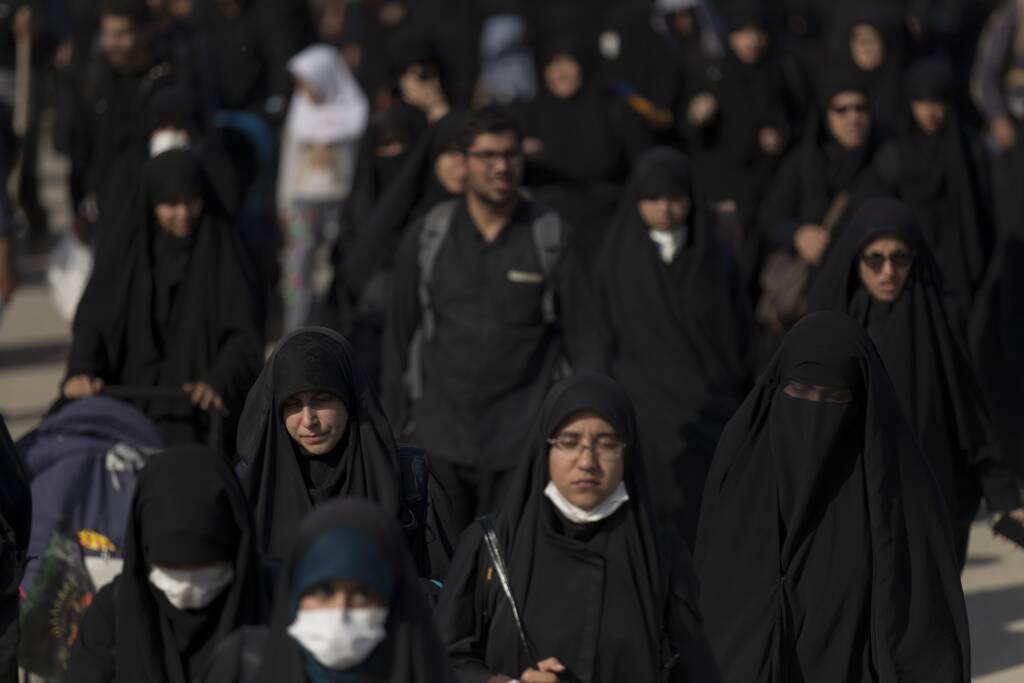
Analysts warn that Iran’s Civil Code further exposes minors to sexual exploitation by setting the legal marriage age for girls at 13 and allowing younger girls to marry with parental consent and court approval.
By Ailin Vilches Arguello, The Algemeiner
In yet another example of Iran’s human rights abuses, the regime is weaponizing human trafficking to fund its regional proxy wars, profiting from the abuse of women, children, and at-risk migrants while forcing marginalized populations into combat to help finance and sustain its network of terrorist groups, a new report has found.
The Jerusalem Center for Security and Foreign Affairs (JCFA), an Israeli research institute focused on security and foreign policy, released a new analysis last week detailing how Iran’s Islamic Revolutionary Guard Corps (IRGC) exploits women, children, undocumented migrants, and refugees to bankroll its regional ambitions and sustain its proxy forces.
“Until the global community treats the IRGC not just as a geopolitical adversary, but as a criminal enterprise deeply reliant on the financial proceeds of human misery, the regime will continue to monetize vulnerability to fund its survival and project its power,” Ella Rosenberg, a senior research fellow at JCFA, writes in the report.
According to JCFA’s analysis, Iran’s anti-trafficking laws give the country grounds to claim compliance with international standards, despite failing to provide adequate protections for victims and refusing to ratify the United Nations’ 2000 Protocol to Prevent, Suppress, and Punish Trafficking in Persons.
Experts warn that the IRGC, a military force charged with defending Iran’s authoritarian regime internally and expanding its Islamist revolutionary ideology externally, profits directly from human trafficking, with sex trafficking — including the exploitation of women through regime-sanctioned temporary marriages — serving as a major source of income.
Given the IRGC’s control over border security and its oversight of internal checkpoints and airports, the report argues that trafficking networks operating within Iran and across its borders into neighboring countries, including Iraq, could not operate on such a large scale without the force’s complicity.
JCFA identifies Iran as a source, transit hub, and destination for the sex trafficking of women and girls, pointing to widespread poverty, entrenched corruption, and economic mismanagement as driving factors that make vulnerable populations more susceptible to exploitation.
Analysts warn that Iran’s Civil Code further exposes minors to sexual exploitation by setting the legal marriage age for girls at 13 and allowing younger girls to marry with parental consent and court approval — leaving children vulnerable to abuse and increasing their risk of becoming victims of human trafficking.
Sex trafficking is only one part of the broader operation, with the JCFA report finding that the IRGC’s Quds Force, which is responsible for overseeing the regime’s operations and terrorist proxies abroad, systematically traffics undocumented migrants, refugees, and children to help finance and sustain the regime’s proxy wars across the Middle East.
Exploiting vulnerable populations to fuel its military ambitions, the IRGC coerces Afghan and Pakistani refugees into combat through deception, financial pressure, and threats of deportation, while forcing Iranian children as young as 12 into military indoctrination and combat-support roles in violation of international law.
Rather than paying and deploying trained IRGC personnel, the regime uses people who receive little or no compensation, treating them as disposable. Experts argue that this system reduces military costs by billions of dollars, freeing up funds for the IRGC’s domestic corporate monopolies, as well as regional terrorist financing networks.
Another major source of revenue for the Iranian regime comes from exploiting migrants fleeing Pakistan and Afghanistan, who face extortion, debt bondage, and forced labor by smuggling networks that pay protection money to the IRGC.
JCFA warns that despite hundreds of US and EU sanctions targeting Iran’s nuclear program, ballistic missiles, terrorism, and domestic repression, human trafficking remains largely overlooked, leaving a critical loophole that allows the IRGC to continue profiting from the exploitation of vulnerable people.
Now, experts are calling on the United States and the European Union to overhaul their sanctions strategies by explicitly targeting the IRGC’s human trafficking operations and treating them as predicate financial crimes.
“The failure to aggressively sanction the IRGC … for human trafficking allows a designated terrorist organization to operate a highly profitable, state-sponsored transnational crime syndicate with near-total impunity,” the report says
Do You Love Israel? Make a Donation - Show Your Support!

Donate to vital charities that help protect Israeli citizens and inspire millions around the world to support Israel too!
Now more than ever, Israel needs your help to fight and win the war -- including on the battlefield of public opinion.
Antisemitism, anti-Israel bias and boycotts are out of control. Israel's enemies are inciting terror and violence against innocent Israelis and Jews around the world. Help us fight back!