
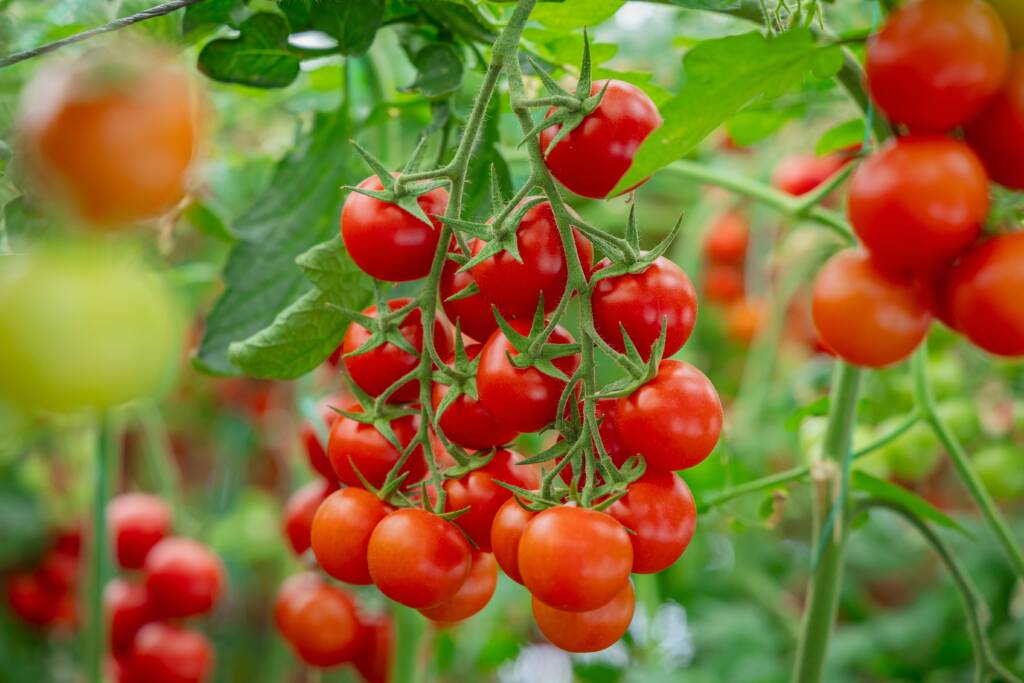
During winter greenhouse trials, the modified plants yielded more than 18 times as many fruits as unmodified plants early in the season.
By Pesach Benson, TPS
Israeli researchers have identified a genetic mechanism that enables tomato plants to produce fruit without fertilization, potentially offering a way to develop varieties with more reliable yields in cold weather.
“Our findings show how tomato plants use a carefully balanced genetic system to coordinate flower development, pollen release and the beginning of fruit growth,” said Prof. Naomi Ori of the Hebrew University of Jerusalem, who led the study with doctoral researcher Nave Man.
Every tomato begins as a flower, and before fruit can grow, a precise sequence of biological events must occur: the flower’s male and female organs must develop together, pollen must be released at the right moment, and fertilization must take place.
Previous research has shown that cold weather can reduce pollen viability and prevent fertilization, while heat can also interfere with fruit formation.
Until now, researchers did not fully understand the genetic system that keeps these processes synchronized or whether it could be manipulated to bypass fertilization failures.
The team included researchers from the Leibniz Institute of Plant Biochemistry in Germany and the Volcani Institute, the research arm of Israel’s Ministry of Agriculture.
The researchers examined a system involved in the plant’s response to auxin, a hormone that regulates growth and development.
Within that system, certain factors promote the hormonal response, while a small regulatory RNA called miR167 acts as a brake on key genes.
Using CRISPR gene-editing technology, which allows scientists to make precise changes to DNA, the researchers modified several genes and made two key discoveries.
First, they found that two closely related genes, called SlARF8A and SlARF8B, work as a team to guide the growth of the flower’s male and female reproductive parts, a role that had not previously been identified.
Second, they found that one of these genes also controls the timing of when the flower’s anthers, the parts that hold pollen, open to release it, meaning the same genetic system also oversees pollen release.
A Genetic Route Around Fertilization
The researchers then edited both sides of this genetic system at once: the genes that drive the process forward and the ones that hold it back. That combination produced a striking result.
The plants began growing fruit even without being fertilized, a natural phenomenon called parthenocarpy, in which fruit develops without fertilization and is typically seedless.
During winter greenhouse trials, the modified plants yielded more than 18 times as many fruits as unmodified plants early in the season.
By harvest, they had produced six times more ripe tomatoes and 10 times the total weight of ripe fruit.
Most of the modified plants’ tomatoes had already turned red and ripened by the end of the trial, while most fruit on the unmodified plants was still green.
The modified plants also grew more compactly and produced fewer stems and leaves.
Because cold weather reduces pollen viability and can prevent fertilization, tomato growers in colder climates or during winter months can see sharply reduced yields.
By enabling fruit to form without fertilization, the genetic mechanism could eventually help tomato varieties bypass this vulnerability.
The winter greenhouse results raise the possibility of extending tomato production into colder months or regions where winter growing has been less reliable.
Although the experiments focused on cold conditions, fertilization failure can also reduce tomato yields during extreme heat.
Because the mechanism bypasses the need for fertilization rather than specifically increasing cold tolerance, the findings raise the possibility that it could also be useful under heat stress.
That possibility, however, remains to be tested.
The researchers said further study is needed before the approach could be used commercially, including examining how the genetic changes affect fruit size, flavor and quality and whether they can be successfully bred into agricultural varieties.
The researchers said the approach could be particularly useful for processing tomatoes, where seedless fruit can be advantageous.
The study was published in the peer-reviewed New Phytologist.
Do You Love Israel? Make a Donation - Show Your Support!


Donate to vital charities that help protect Israeli citizens and inspire millions around the world to support Israel too!
Now more than ever, Israel needs your help to fight and win the war -- including on the battlefield of public opinion.
Antisemitism, anti-Israel bias and boycotts are out of control. Israel's enemies are inciting terror and violence against innocent Israelis and Jews around the world. Help us fight back!