
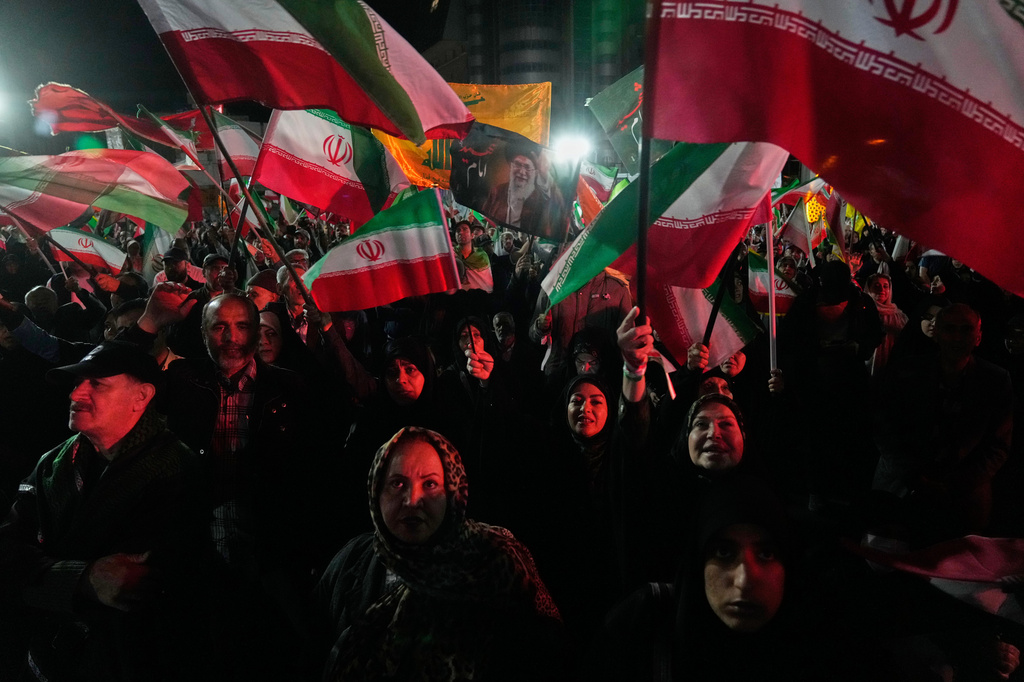
Disagreements within the regime over policy and personnel do not necessarily mean that its principal institutions are preparing to abandon the existing system.
By Maddie Ali, The Algemeiner
The death of Ali Khamenei, a new supreme leader to replace him, mass anti-government protests, and mounting economic pressure have shaken Iran’s ruling system over the past year of upheaval.
Yet the Islamic Republic remains in power, supported by its security apparatus and an establishment that has so far avoided a decisive split.
These developments have raised questions about why a regime facing such extensive domestic and external pressure has not collapsed.
The answer lies partly in the cohesion of Iran’s security establishment, the survival of its political institutions, and the absence of a unified opposition capable of coordinating a transition.
The latest major wave of nationwide protests began on Dec. 28, 2025, amid rising prices and the collapse of the currency’s value.
Demonstrations that initially focused on economic grievances quickly developed into a broader challenge to clerical rule.
Iranian authorities responded with a bloody crackdown, killing thousands of peaceful protesters, arresting thousands more, and initiating a wave of mass executions of prisoners.
The scale of violence highlighted the government’s brutality and willingness to use force to stay in power.
The protests exposed the wide extent of public anger but did not produce a decisive break within the institutions responsible for maintaining the regime’s authority and control.
That distinction remains central to understanding the Islamic Republic’s survival.
Large demonstrations can challenge the regime’s legitimacy, but they do not necessarily remove its ability to remain in power when security forces stay loyal, and state institutions continue functioning.
The death of Khamenei in late February during US-Israeli strikes created the most consequential leadership crisis in the Islamic Republic’s history since its founding in 1979.
His son, Mojtaba Khamenei, was appointed the next supreme leader.
However, he has not appeared publicly or released a direct audio or video message since taking office, raising questions about who is exercising power behind the scenes.
Iranian officials have insisted that Khamenei remains involved in decision-making, but his prolonged absence has fueled uncertainty about the leadership of the Islamic Republic.
The Islamic Revolutionary Guard Corps (IRGC), the Basij paramilitary force, and intelligence agencies remain among the most important pillars of the Islamist regime.
The security establishment’s continued cohesion has allowed the government to respond to successive crises without losing control of the country’s principal institutions.
War with the US has also strengthened the position of military figures within the political system.
The IRGC, a military force charged with defending Iran’s authoritarian regime internally and expanding its Islamist revolutionary ideology externally, has been consolidating its influence at the expense of some civilian and clerical institutions, even as disputes continue among government officials over negotiations with the West, economic policy, and the response to public discontent.
These disagreements have not yet resulted in a decisive fracture capable of threatening the system’s survival.
Iran’s economic crisis has intensified under the combined weight of sanctions, disrupted trade, currency depreciation, and the costs of war.
The economic consequences have extended beyond financial markets, affecting households, businesses, and the government’s ability to restore confidence.
The Iranian rial has continued to depreciate, and foreign-currency shortages are adding to the pressure. Concerns have also grown over the ability to pay the salaries of military and law enforcement personnel.
This deterioration has created competing pressures within the ruling establishment.
Officials concerned about public anger face calls to address living costs and shortages, while security hardliners have pushed for tougher measures against perceived threats to the regime.
Political infighting has increased, with hardliners successfully forcing the recent resignation of Oil Minister Mohsen Paknejad and pressing for the removal of Foreign Minister Abbas Araghchi, adding pressure on President Masoud Pezeshkian.
The disputes indicate that the government is under strain. However, disagreements over policy and personnel do not necessarily mean that its principal institutions are preparing to abandon the existing system.
Iranian opposition groups differ over the country’s future political system, leadership, and role of figures living abroad. Some advocate a secular democratic republic, while others support a constitutional monarchy or alternative political arrangements.
These differences have made it difficult to establish a single leadership structure capable of coordinating sustained nationwide mobilization and presenting a broadly accepted plan for transition. The current prolonged conflict has not produced a viable opposition force capable of overthrowing the regime.
The Islamic Republic is entering the final months of 2026 facing several simultaneous challenges: economic deterioration, the consequences of the ongoing war, internal political disputes, and the lingering effects of the January protests.
Diplomatic tensions also remain unresolved. On Oct. 18, Araghchi said Iran’s proposal to reopen the Strait of Hormuz, the maritime chokepoint critical for global energy trade, remained on the table, conditional on Washington accepting Tehran’s demands.
The negotiations reflect the continuing confrontation between the two countries and the absence of a settled political or security arrangement.
For now, the Islamic Republic’s survival reflects its security apparatus remaining largely unified, prepared to crush dissent and tighten its grip on the country’s political institutions despite the loss of senior leaders and mounting pressure on the regime.
The developments of the past year have exposed serious vulnerabilities within the system, but they have not yet produced the combination of institutional breakdown, security-force defections, and coordinated political opposition that analysts identify as potential triggers for its collapse.
Do You Love Israel? Make a Donation - Show Your Support!

Donate to vital charities that help protect Israeli citizens and inspire millions around the world to support Israel too!
Now more than ever, Israel needs your help to fight and win the war -- including on the battlefield of public opinion.
Antisemitism, anti-Israel bias and boycotts are out of control. Israel's enemies are inciting terror and violence against innocent Israelis and Jews around the world. Help us fight back!