
According to assessments in Israel in recent months, Operation Roaring Lion/Epic Fury, which began on Feb. 28, massively degraded Iranian missile production industries, striking nearly every significant site involved in the missile production chain.
By Yaakov Lappin, JNS
Iran is working to convert its fortified Pickaxe Mountain tunnel complex into a substitute uranium enrichment site to replace facilities destroyed at Fordow and Natanz, Brig. Gen. (res.) Prof. Yaakov (Jacob) Nagel, a senior fellow at the Washington-based Foundation for Defense of Democracies and the former head of Israel’s National Security Council, told JNS.
Following international media and think tank reports of movement and construction work at the deep underground site, known in Farsi as Kuh-e Kolang Gaz La, Nagel said Tehran’s motive traces back to the 2015 nuclear deal brokered by the Obama administration.
“There is no doubt that Iran is planning to use the Pickaxe Mountain infrastructure as an alternative base, in their assessment a protected one, in order to replace the enrichment sites that were hit at Fordow and Natanz. The terrible 2015 agreement allowed them to develop advanced centrifuges that enrich at a rate 10 times faster than before, and some of them survived,” said Nagel.
The risk of such centrifuges being transferred to Pickaxe Mountain, in central Iran close to the Natanz nuclear complex, together with some of the enriched material, is a risk, Nagel warned.
He added that the enrichment level of any relocated material matters less than it might seem.
“Material enriched to 20% or even less can be enriched quickly to 90% plus. This is true even if it takes relatively longer than material enriched to 60%. Enrichment to 20% takes about 70% of the time required for enrichment to 90%,” he said.
“The bigger problem is the ability to also transfer to this site laboratories and capabilities for building the weaponization program, for building the weapon system. It is not clear what has already been done and what is planned, but this site must disappear or reach a state in which it cannot be used so that Iran does not enter the zone of immunity,” Nagel said.
Turning to the Taleghan 2 facility at the Parchin military complex, southeast of Tehran, where satellite imagery has shown recent reconstruction activity, Nagel said Iran has long denied any nuclear connection to the site, specifically to try and shield it from attack.
“According to foreign reports, development of components related to the [nuclear] weapon system was carried out at this site, under a cover of denial of dual-use capabilities, so it makes sense that it will apparently remain a target in any future plan,” he said.
Asked about a Sept. 10 Wall Street Journal report stating that Iran has resumed accelerated assembly of ballistic missiles from stockpiles of pre-manufactured components inside underground facilities, Nagel said the effort appears limited in scope.
“I join the assumption that Iran is trying to rehabilitate some of its underground production capabilities, but at a pace that is at least an order of magnitude smaller than what was planned, but it is still troubling and requires handling,” he said.
On the best options in Iran going forward, Nagel stated, “A heavy siege by sea, air, and land, if it is accompanied by American patience over time, six to nine months, holds within it the potential to collapse the economy and bring the people back out into the streets. I’m not sure there will be patience and I’m not sure it will bring the people out into the streets, but this, combined with a few more actions, brings potential.”
Nagel was skeptical of American appetite for a ground operation at Pickaxe Mountain. “It’s possible the U.S. has aerial strike capabilities against the site, even though that would be difficult,” he said.
According to assessments in Israel in recent months, Operation Roaring Lion/Epic Fury, which began on Feb. 28, massively degraded Iranian missile production industries, striking nearly every significant site involved in the missile production chain.
Construction at Pickaxe Mountain
Brig. Gen. (res.) Yossi Kuperwasser, head of the Jerusalem Institute for Strategy and Security and former head of the Research and Assessment Divisions of the IDF Military Intelligence Directorate, told JNS in July that the missile production chain was hit especially hard.
“Enormous damage was caused to the Iranian nuclear program and also to the ballistic missiles that are part of the Iranian nuclear program. The ability to produce new missiles was damaged,” Kuperwasser said, adding that the uranium conversion facility at Isfahan “was essentially destroyed.”
International Atomic Energy Agency Director-General Rafael Grossi told Bloomberg on Sept. 10 that satellite imagery had picked up construction activity at Pickaxe Mountain, though the agency has not inspected the underground complex.
“There are some indications that there is movement around this construction site,” Grossi said, adding, “We don’t have any concrete information as to activities that may be taking place there.
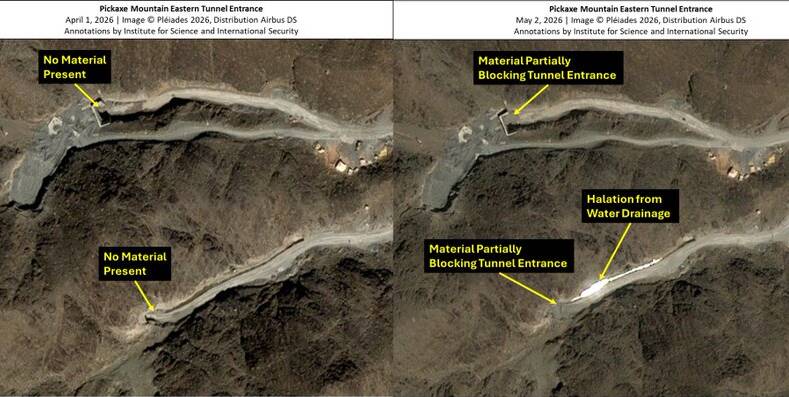
The Institute for Science and International Security, the think tank founded by former nuclear weapons inspector David Albright, reported on Sept. 17 that satellite imagery showed Iran had placed earthen roadblocks across roads leading to the site’s western tunnel entrances in late July and early August, restricting vehicle access, while its eastern tunnel portals had separately been partially backfilled with dirt earlier in the year.
The institute said the continued restrictions on access reinforce its assessment that the facility is not currently being used for normal operations, while cautioning that valuable equipment or materials may remain inside.
The same institute reported in recent days that Iran is “rapidly reconstructing” the Taleghan 2 facility at Parchin, following an earlier report on July 10 that documented what it called “significant activities indicative of an Iranian commitment to repair and reconstruct the site,” including excavation around bomb-penetration holes in the facility’s roof and additional concrete reinforcement.
Do You Love Israel? Make a Donation - Show Your Support!


Donate to vital charities that help protect Israeli citizens and inspire millions around the world to support Israel too!
Now more than ever, Israel needs your help to fight and win the war -- including on the battlefield of public opinion.
Antisemitism, anti-Israel bias and boycotts are out of control. Israel's enemies are inciting terror and violence against innocent Israelis and Jews around the world. Help us fight back!