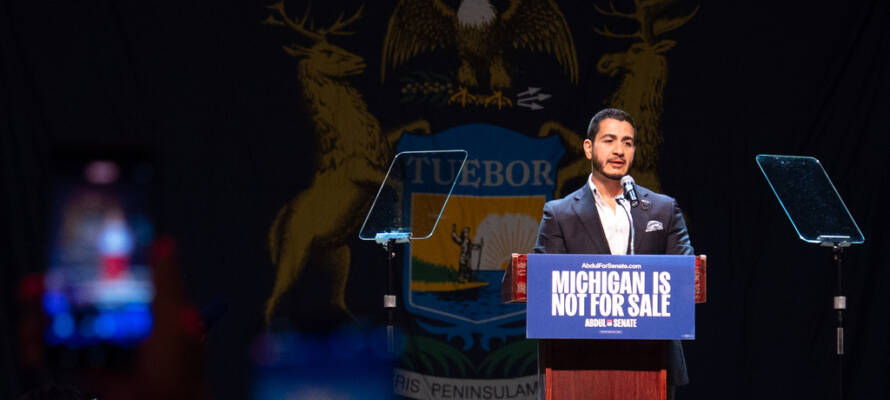
El-Sayed has repeatedly accused Israel of committing genocide in Gaza and has described both Hamas and the Israeli government as “evil.”
By United with Israel Staff
Progressive anti-Israel candidate Dr. Abdul El-Sayed has won Michigan’s Democratic Senate primary, defeating Rep. Haley Stevens in one of the most expensive and closely watched Democratic primaries in U.S. history.
Following a prolonged vote count, El-Sayed secured the nomination after a bitter campaign that exposed deep divisions within the Democratic Party over Israel and the party’s ideological direction. He will face former Republican Congressman Mike Rogers, who ran unopposed in the GOP primary, in November’s general election for the seat being vacated by retiring Sen. Gary Peters.
The race became a proxy battle over Israel, with El-Sayed emerging as one of the Democratic Party’s most outspoken critics of the Jewish state.
A former public health official and national surrogate for Sen. Bernie Sanders’ 2020 presidential campaign, El-Sayed has repeatedly accused Israel of committing genocide in Gaza, described both Hamas and the Israeli government as “evil,” called Israel a “rogue state,” argued that the United States should end what he called “blank checks” for the Israeli military, and questioned the concept of Israel as a Jewish state, saying he does not believe in “ethno-states.” During the 2026 Iran conflict, he also suggested that AIPAC’s influence shaped U.S. policy toward Iran.
Stevens, by contrast, campaigned as a “proud pro-Israel Democrat.” She has strongly opposed the Boycott, Divestment and Sanctions (BDS) movement, defended Israel’s right to exist as a Jewish state, supported continued U.S. military aid, and has described Israel as “America’s strong ally,” “a democracy,” and “a beacon of hope.”
More than $80 million was spent on the primary, making it the most expensive Democratic Senate primary in U.S. history. The largest outside spender was United Democracy Project, an AIPAC-affiliated super PAC, which invested heavily in support of Stevens and against El-Sayed.
In his victory speech, El-Sayed sought to reassure Jewish voters despite his sharp criticism of Israel and AIPAC throughout the campaign.
Addressing Jewish Americans directly, he said his “commitment to Jewish safety” was the same as his commitment to the safety of his own daughters. He also praised Jewish supporters who, he said, believed “AIPAC doesn’t speak for me” and argued that Palestinian self-determination does not come at the expense of Jewish self-determination.
President Donald Trump reacted to the result by calling El-Sayed’s victory “great news for the Republican Party,” describing the Democrat as a “Communist loser who hates Jews and Israel.” Trump has endorsed Republican nominee Mike Rogers, who now faces El-Sayed in what is expected to be one of the nation’s most competitive Senate races.
Beyond deciding Michigan’s next Democratic nominee, the primary is widely viewed as a significant test of the Democratic Party’s future direction on Israel, with El-Sayed’s victory marking a major win for the party’s progressive wing ahead of November’s general election.