
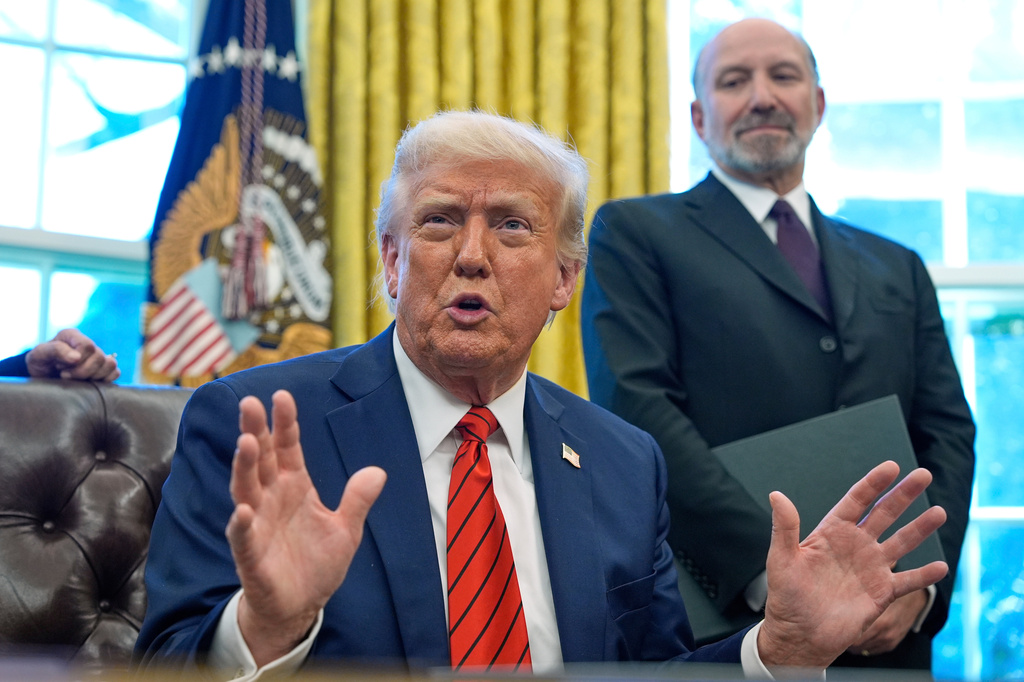
Trump’s detractors do exactly what he did in a 2019 tweet by exaggerating the cost of the war and dismissing its results as not worth a candle.
By Amir Taheri, Gatestone Institute
“The United States has spent EIGHT TRILLION DOLLARS fighting and policing in the Middle East. Thousands of our Great Soldiers have died or been badly wounded. Millions of people have died on the other side. GOING INTO THE MIDDLE EAST IS THE WORST DECISION EVER MADE IN THE HISTORY OF OUR COUNTRY! …”
The above was posted by President Donald J. Trump on October 9, 2019, during his first term as president.
The capital letters are his, as are the inflated numbers about dollar spending and those who supposedly died on the other side.
Notice that in his tweet, Trump gives top billing to the money spent before mentioning the cost in human lives.
Nevertheless, the Trump tweet raised an important issue: that American elites drunk on hubris were beating the drums about easy victories in Afghanistan and Iraq.
What Trump didn’t know at the time was that the tweet may one day be flung back into his own face. Yet this is what some of his erstwhile MAGA followers are doing with reference to the strange war he launched against the Islamic Republic of Iran.
Trump’s detractors do exactly what he did in his tweet by exaggerating the cost of the war and dismissing its results as not worth a candle.
But what if Trump was wrong then and his critics are wrong now?
The first US “going into the Middle East” happened in August 1942, a year after Britain and the USSR invaded Iran, toppled its Shah, and started using its infrastructure and food resources to support the Red Army fighting Nazi Germany.
The US sent 30,000 non-combat troops, mostly logistics, administrative, commercial, and health experts, to reorganize the chaotic system conjured up by Brits and Russians who took from Iranians what they wished but paid in future-dated IOUs instead of cash.
The arrangement suited the occupiers but bankrupted Iranian businesses and led to famine in several provinces.
“What a relief,” wrote Ibrahim Khajenuri, an Iranian journalist at the time, “while Russians and the English (sic) steal, Americans buy with real money.”
At the same time, the US paid for the upkeep of over 300,000 European refugees, including thousands of Polish Jews who had fled to the USSR but were pushed into Iran by Stalin.
Without US financial and administrative support, the war-shattered Iranian state would not have been able to look after the surprise guests beyond an initial welcome.
In 1945, President Franklin D. Roosevelt held a summit with Saudi King Abdul-Aziz Ibn Saud aboard an American warship to seal a friendship that has lasted to this day with benefit for both sides.
The US agreed to expanded financial and strategic assistance to Saudi Arabia, which was used to develop the kingdom’s oil resources, something that British diplomat Lancelot Oliphant had refused when, in 1932, Saudis asked the United Kingdom for a loan of half a million pounds sterling.
Oliphant’s rejection was later portrayed as a notorious British diplomatic and commercial miscalculation, earning him the label “the diplomat who said ‘No’ to Saudi oil.”
The Abdul-Aziz-Roosevelt meeting happened on February 14, but I doubt if either knew it was Valentine’s Day.
The next US intervention was in Iran, when President Harry S. Truman opposed Stalin’s plan to annex parts of northwest Iran under Red Army occupation in violation of a 1942 accord by Allies to withdraw at the end of the war.
US aid through CARE and Point IV schemes helped post-war Iran avoid famine, introduce mass vaccination to cut child mortality by 70 percent, and train a cadre of Iranian managers, economists, and health workers.
In 1951, Truman intervened to “discourage” the Labour Party Government in London from invading Iran to seize oilfields and installations and undo Iranian oil nationalization.
In 1956 President Dwight D. Eisenhower intervened to stop the Suez War and prevent Britain and France, two moribund imperialist powers, from gaining a new lease on life.
Next it was the turn of President John F. Kennedy, who as a US Senator opposed France’s colonial war in Algeria and as president helped Charles De Gaulle to sell the idea of Algerian independence to his compatriots.
The two US interventions in Lebanon in 1958 and 1982 brought that country back from the brink.
Fast forward from the mid-1960s: the US has acted as Israel’s key ally and central player in the quest for a settlement between Israel and its Arab neighbors.
Because it was able to talk to both sides, the US succeeded in marginalizing the initial ideological-religious causes of the conflict and redefining it in political and diplomatic terms.
Though limited, Trump’s own success with the Abraham Accords is the latest example.
Trump’s tweet was implicitly focused on Afghanistan and Iraq, which the US invaded, spent a lot of money on, and sustained human losses, though not on the scale he suggests.
Even in those two nations, US intervention wasn’t as negative as some suggest.
Iraq today is still grappling with many problems, including mafia-style proxies of Tehran and Ankara’s troops in several provinces.
Corruption is also above the 40 percent the UN regards as a limit beyond which it becomes “a way of life.”
Yet, no one can deny that Iraqis today are freer, more secure and respected and generally more prosperous than under various post-monarchy dictators.
The Afghan case is somewhat different, if only because, unlike in Iraq, those ousted from power have returned. Even then, thanks to US intervention in 2001, Afghans tasted two decades of relative freedom.
As a student of Afghan affairs and a frequent visitor for decades, I am astonished by the amazing achievements of Afghans in art, culture, literature, sport, and even business during that brief parenthesis.
Millions of Afghan girls managed to get schooling and secure a part, albeit small, in public life. Part of that historic surge of creativity has happened in the Afghan diaspora, formed after the return of the Taliban to power.
However, even if we don’t like the Taliban, who are not likeable by any measure, they too may have started to change because the country the Americans left isn’t what it was before they came.
Right now, voices are heard inside Afghanistan urging a review of the ban on education for women, partly by the Taliban’s own womenfolk, who somehow have caught the American bug.
Iranians had no reason to oppose US intervention when it helped them protect their sovereignty against the Soviets and the British.
They pushed the US into hostility by raiding its embassy in Tehran, effectively starting a 47-year war.
It is too early to assess the current US “intervention” in Iran, and much depends on how it ends.
Arabs have little reason to denounce the US intervention, which helped prevent Israel from translating its military victories into political gains.
Even today, Trump is trying to save Hamas from extinction through his “Board of Peace” while also shielding the Lebanese Hezbollah to please Tehran and Doha.
Egypt can’t complain about having received almost $100 billion in US aid through annual subsidies by signing a peace treaty with Israel.
Kuwait can’t complain because the US saved it from being annexed by Iraq under Saddam Hussein.
All in all, US intervention in the Middle East has not been all negative, as Trump suggests.
His own behavior could tip the balance.
Do You Love Israel? Make a Donation - Show Your Support!


Donate to vital charities that help protect Israeli citizens and inspire millions around the world to support Israel too!
Now more than ever, Israel needs your help to fight and win the war -- including on the battlefield of public opinion.
Antisemitism, anti-Israel bias and boycotts are out of control. Israel's enemies are inciting terror and violence against innocent Israelis and Jews around the world. Help us fight back!