Israel, Greece and Cyprus jointly rejected a maritime boundary agreement between Turkey and Libya’s Government of National Accord, which was ratified by Libya’s House of Representatives last month.
By United with Israel Staff
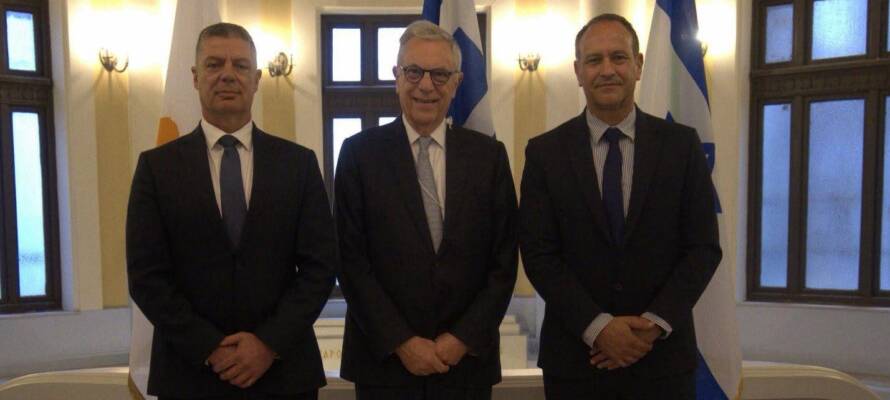
Israel, Greece and Cyprus agreed Thursday to deepen their defense cooperation and strengthen regional security coordination during a trilateral meeting in Athens, while jointly rejecting a controversial maritime agreement between Turkey and Libya.
Senior defense officials from the three countries met to discuss shared security challenges in the Eastern Mediterranean, including terrorism, advanced weapons proliferation, maritime security and threats to critical infrastructure.
The meeting followed a joint declaration adopted at a leaders’ summit in Jerusalem on December 22, 2025, reaffirming the three countries’ growing strategic partnership.
The officials discussed expanding cooperation between their defense industries, including joint weapons development, production and technological innovation.
They also examined plans to establish a trilateral defense industry working group, increase professional exchanges and identify new joint initiatives to strengthen their military capabilities and operational coordination.
Maritime security featured prominently in the discussions, with particular attention to protecting vital shipping routes, energy infrastructure and regional supply networks.
The three countries emphasized their shared commitment to regional stability and opposition to destabilizing military activity by state and non-state actors.
In a significant diplomatic statement, Israel, Greece and Cyprus jointly rejected a maritime boundary agreement between Turkey and Libya’s Government of National Accord, which was ratified by Libya’s House of Representatives on October 20, 2026.
The three defense ministries declared that the agreement undermines the sovereign rights of third countries, disregards international maritime norms and cannot create legal obligations for states that are not parties to it.
The officials also reaffirmed their support for the sovereignty, independence and territorial integrity of Cyprus, while opposing unilateral territorial claims, coercion and threats of military force.
The dispute reflects longstanding tensions in the Eastern Mediterranean over maritime boundaries, offshore energy resources and Turkey’s regional ambitions.
Energy cooperation was another major focus, with the three countries emphasizing the importance of protecting energy supply routes and critical infrastructure connecting Europe and the Middle East.
They also discussed disaster preparedness, emergency response and civil defense cooperation.
The defense ministries reaffirmed their commitment to strengthening the trilateral partnership, describing it as an important framework for regional security and closer strategic ties between Europe and the Middle East.
The officials agreed to continue regular consultations and pursue practical initiatives aimed at expanding defense cooperation and addressing emerging threats across the Eastern Mediterranean.