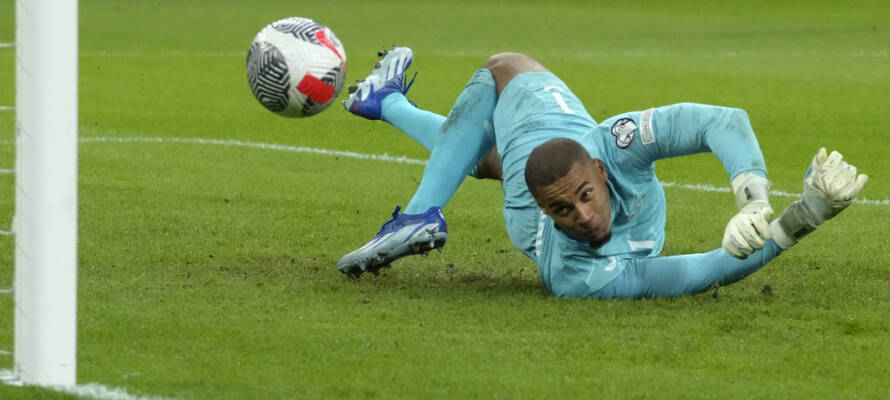
“My decision is based purely upon my personal belief that the killing of innocent people is wrong,” Bazunu said.
By United with Israel Staff
Ireland’s national soccer team was thrown into turmoil on the eve of its Nations League match against Israel, with goalkeeper Gavin Bazunu withdrawing from the squad rather than face the Israeli team as his teammates rejected calls for a boycott.
Hours of tense internal discussions on Saturday forced Ireland to postpone its scheduled press conference and training session in Debrecen, Hungary, by more than five hours. The players ultimately voted by a significant majority to fulfill the fixture and agreed to wear black armbands in recognition of “all lives lost in the conflict.”
Bazunu, 24, chose instead to leave the squad, saying playing against Israel would violate his personal principles.
“Representing my country means everything to me,” Bazunu wrote on Instagram, adding that he believed “it would be wrong to participate in the upcoming fixtures against Israel.”
“My decision is based purely upon my personal belief that the killing of innocent people is wrong,” he said, stressing that his decision was not directed against Israelis or Jews but against what he called “the atrocities in the region.”
The goalkeeper’s decision came after weeks of mounting political and public pressure in Ireland for the national team to refuse to play Israel.
The controversy has exposed divisions within the squad itself. Ireland manager Heimir Hallgrímsson acknowledged before the international window that some players felt “really uncomfortable” about the Israel matches, while midfielder Jason Knight publicly said he did not believe the games should take place.
The Football Association of Ireland nevertheless decided to fulfill both fixtures. The association previously warned that a boycott could cost Irish soccer at least €5.5 million in lost revenue and expose it to additional UEFA sanctions. In July, FAI general assembly delegates voted 75-38 in favor of playing the games.
Ireland is scheduled to face Israel in Debrecen on Sunday before the teams meet again on Oct. 4 in Bačka Topola, Serbia. Both games are being played at neutral venues.
The extraordinary buildup has already spilled well beyond the field. The FAI asked UEFA earlier this year to prevent Ireland and Israel from being drawn against one another in future competitions, but UEFA rejected the request, saying the countries had no history of “direct conflict” and that such decisions were not based on public sentiment.
The association has also stripped sponsor branding from activities surrounding the current international window and sharply reduced media and promotional activity around the Israel fixtures. Irish broadcaster RTÉ is showing the matches without its normal studio coverage, while radio station Newstalk opted not to provide live commentary.
Despite the controversy, the Israel Football Association welcomed Ireland’s decision to take the field.
“What pleases us today is that football has won,” the association said Saturday, arguing that “the separation between football and politics must be maintained.”
“The ones who have certainly lost today are those who wanted to intimidate, to separate and to turn the football pitch into a political arena,” it added.
The Israeli association said both teams would have the opportunity to take part in the normal pre-match ceremonies, including the raising of national flags, playing of anthems and exchanges between players and coaches.
“Let’s play ball!” it concluded.
Separate reports have also raised questions about the future of Finn Azaz, the Jewish midfielder in the Ireland squad, amid the bitter dispute over the Israel fixtures. Irish media reported that officials are concerned Azaz could consider stepping away from the national team following the recent controversy.
The turmoil leaves Ireland heading into Sunday’s match against Israel after days of internal debate, boycott pressure and the withdrawal of one of its most prominent players. Despite the controversy, the team will take the field, with the Israeli Football Association declaring that “football has won” and calling for politics to be kept off the pitch.
Sunday’s match is scheduled to kick off in Debrecen at 7:45 p.m. local time.
Do You Love Israel? Make a Donation - Show Your Support!

Donate to vital charities that help protect Israeli citizens and inspire millions around the world to support Israel too!
Now more than ever, Israel needs your help to fight and win the war -- including on the battlefield of public opinion.
Antisemitism, anti-Israel bias and boycotts are out of control. Israel's enemies are inciting terror and violence against innocent Israelis and Jews around the world. Help us fight back!