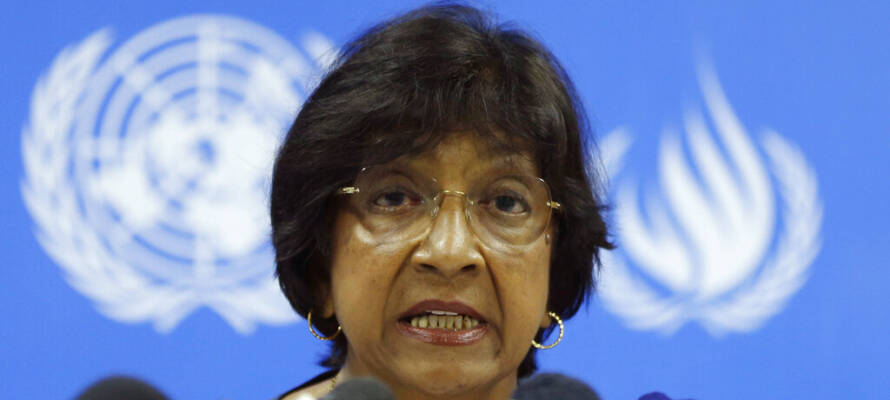
Pillay accused Israel of deliberately using starvation as a weapon of war, destroying Gaza’s medical system and blocking humanitarian aid.
By United with Israel Staff
South African jurist Navi Pillay, who led a controversial United Nations commission that accused Israel of committing genocide in Gaza, was awarded the 2026 Nobel Peace Prize on Friday.
The Norwegian Nobel Committee awarded the prize to the 85-year-old jurist “for her efforts to promote peace and international law,” praising her career promoting accountability for war crimes, crimes against humanity and genocide.
Pillay, a former UN high commissioner for human rights, has served as a judge at the International Criminal Court and as president of the International Criminal Tribunal for Rwanda. She is currently serving as a judge at the International Court of Justice in the genocide case against Myanmar.
But Pillay has also built a lengthy record of harsh criticism of Israel and support for punitive measures against the Jewish state.
Until last year, she chaired the UN Independent International Commission of Inquiry on the Occupied Palestinian Territory, including East Jerusalem, and Israel, which in September 2025 accused Israel of committing genocide in Gaza.
The commission is an independent investigative body established by the UN Human Rights Council and does not speak for the UN as a whole. Its finding was also not a judgment by the International Court of Justice, which has not ruled that Israel committed genocide in Gaza.
Pillay nevertheless presented the commission’s conclusion in unequivocal terms.
“Israel has committed genocide against Palestinians in Gaza,” she wrote when the report was released, arguing that the evidence demonstrated not only genocidal acts but an intent to destroy Palestinians in Gaza.
“These are not the accidents of war,” Pillay wrote of the destruction and civilian deaths in Gaza. “They are acts calculated to bring about the destruction of a people.”
She also accused Israel of deliberately using starvation as a weapon of war, destroying Gaza’s medical system and blocking humanitarian aid.
Pillay placed responsibility directly on Israel’s senior leadership, accusing Prime Minister Benjamin Netanyahu, President Isaac Herzog and former Defense Minister Yoav Gallant of using rhetoric that demonstrated genocidal intent.
The commission later formally accused the three Israeli leaders of inciting genocide.
Pillay went further by invoking the Holocaust and the international community’s failure to prevent the Rwandan genocide.
“The Genocide Convention was born from the ashes of the Holocaust with a solemn vow: ‘Never again,’” she wrote. “That vow is meaningless if it applies only to some and not to others.”
Israel vehemently rejected the commission’s conclusions, calling its report “distorted and false” and accusing the panel of selectively using evidence, relying on Hamas claims and exceeding its authority.
Israel’s Foreign Ministry said the commission had “masquerad[ed] as a quasi-judicial body” while attempting to promote what it called a malicious genocide narrative against the Jewish state.
“Israel remains committed to international law,” the ministry said, arguing that the IDF was fighting to dismantle Hamas while devoting extensive resources to minimizing civilian casualties and facilitating humanitarian aid.
Pillay’s criticism of Israel also predates the Gaza war.
In 2017, she expressed support for the Palestinian BDS campaign, saying she hoped the Palestinian struggle would gain momentum “especially in the civilian campaign of BDS, Boycott, Divestment, and Sanctions.”
In 2020, Pillay was among more than 250 prominent figures who endorsed a South African campaign calling for sanctions against Israel, including a military embargo, restrictions on trade with Israeli communities in Judea and Samaria and the suspension of trade agreements.
That record had prompted accusations of bias even before the commission issued its genocide finding, with critics arguing that Pillay had publicly taken positions on Israel that overlapped with issues she would later be tasked with investigating.
The Nobel Committee, however, focused on Pillay’s broader legal career, which included opposing apartheid in South Africa, defending political prisoners and serving on international tribunals.
The committee praised what it called her “firm moral compass” and said her career demonstrated the importance of international law in resolving conflicts without violence.
Israel responded furiously to Pillay’s selection, accusing the Nobel Committee of rewarding one of the most prominent voices behind what it described as the demonization of the Jewish state.
“If there were an award for lies, hatred, and blood libels, Navi Pillay wouldn’t just be a contender. She’d be a frontrunner,” Israel’s Foreign Ministry said Friday.
“Her role in the relentless, politically motivated demonization of Israel and promotion of the genocide lie speaks volumes,” the ministry added.
The Foreign Ministry said awarding Pillay the Nobel Peace Prize represented a “grotesque weaponization” of the award to legitimize “anti-Israel hatred and prejudice.”
“Now that the Nobel commission has rewarded the biggest lie of the 21st century, Joseph Goebbels is certainly applauding from hell,” the ministry concluded.
Do You Love Israel? Make a Donation - Show Your Support!

Donate to vital charities that help protect Israeli citizens and inspire millions around the world to support Israel too!
Now more than ever, Israel needs your help to fight and win the war -- including on the battlefield of public opinion.
Antisemitism, anti-Israel bias and boycotts are out of control. Israel's enemies are inciting terror and violence against innocent Israelis and Jews around the world. Help us fight back!
STAND WTH ISRAEL - MAKE A DONATION TODAY!