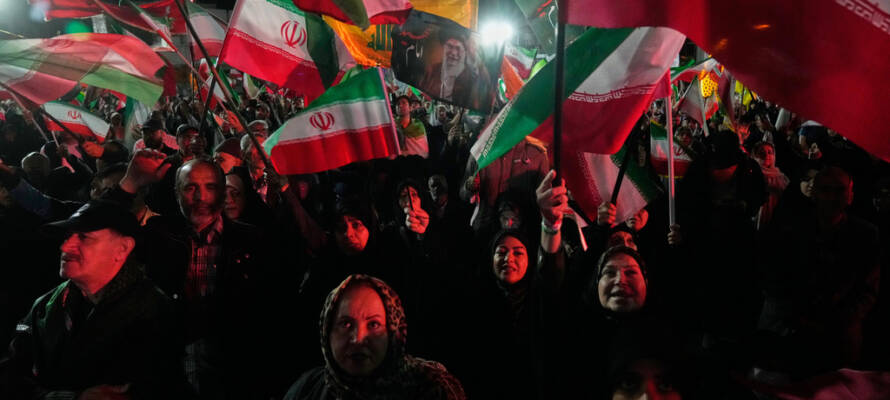
Tehran is trying to synchronize operations and messaging among the Houthis, Iraqi militias, Hamas, and Hezbollah.
By Yaakov Lappin, JNS
A visit by senior Hamas official Bassem Naim to Tehran in recent days, combined with a warning from Israel’s defense minister that Iran could lash out as economic pressure mounts on the Islamic Republic, has sharpened questions over what Tehran and what remains of its axis might attempt during the Jewish High Holiday period and beyond.
Naim, a member of Hamas’s political bureau, met separately in Tehran with Iranian Foreign Minister Abbas Araghchi and Parliament Speaker Mohammad Bagher Ghalibaf this week, according to Iranian and Palestinian media reports.
During the meetings, Araghchi reiterated Iran’s support for Hamas, while Ghalibaf said confronting the United States and its regional policies had become a shared goal of Iran and its terror proxies.
Israeli Defense Minister Israel Katz, addressing Defense Ministry employees at a Rosh Hashanah toast on Sept. 3, said Israel was seeing signs suggesting that severe economic pressure on Iran, along with fears of an uprising and regime collapse, could push Tehran toward acts of desperation.
“There are signs we are seeing that indicate that the severe economic pressure Iran is under and the fear of an uprising and of the regime’s collapse could push them toward steps of desperation,” Katz said.
He warned, “An Iranian attack on Israel will free Israel from every existing constraint on an attack on Iran. We will strike all the national, military, and civilian infrastructure in Iran—including energy infrastructure—and send Iran deep back into the Stone Age and darkness. Israel is well-prepared in defense and offense for every possibility, and the IDF is ready to carry out the mission.”
Pressure from within
Beni Sabti, a founding member of the IDF’s Persian-language media division and a lecturer, researcher, and Iran commentator at the Institute for National Security Studies (INSS), told JNS that Iran’s clerical leadership has shown no sign of softening under domestic pressure, unlike the shah’s government during the protests that preceded the 1979 Islamic Revolution.
“The regime today does not give up. It will, for now, stand and continue to stand against pressure from home, and there is some protest and some pressure, but it depends very much on the scale of the pressure from inside Iran,” Sabti said.
He added that if protests involving tens or hundreds of thousands of Iranians were to erupt, the regime could struggle to contain them as it did in the past.
He noted that some police and security personnel have begun filming themselves with their faces exposed and posting online that their situation has become untenable.
Sabti described this as reflecting despair and growing estrangement from the regime rather than outright defection, adding that an imminent gasoline price increase represents another source of public anger.
“Yes, the regime behaved like Hamas. They will be like a terror organization; they will shoot at everyone. But if the public is truly desperate, this can be very, very strong and not allow the regime to overcome it,” he said, stressing that everything depends on the scale and numbers involved.
On the question of striking Iranian infrastructure, Sabti argued that hitting energy and industrial targets inside Iran would do little to change the regime’s calculus, since ordinary Iranians are already suffering severe shortages of electricity, water, and fuel.
He said Israel should instead focus on Iran’s military leadership rather than infrastructure that is already failing the population.
Sabti said Tehran is trying to synchronize operations and messaging among the Houthis, Iraqi militias, Hamas, and Hezbollah, but that both Hezbollah and Hamas are consumed by financial and organizational strains of their own, with Hezbollah fighters reportedly unpaid for some time.
He characterized Naim’s visit as useful mainly for securing moral backing and functioning largely as psychological warfare rather than operational coordination.
The Houthis and Iraqi militias remain more capable of acting on Iran’s behalf, he said, but cannot compare to Hezbollah, which he described as far more dangerous due to its proximity to Israel’s northern border.
Sabti said the fall of the Ali Taher ridge area in Southern Lebanon triggered visible embarrassment on Iranian and Hezbollah television, whose commentators struggled to explain why promised reinforcement never came.
“This isn’t working for the regime,” Sabti said. He warned, however, that if Iran were suddenly given access to new funds, or if the naval blockade were lifted and it could export more oil, it would strengthen once again.
‘Economic strangulation’
The Islamic Republic’s economic strain has deepened in recent days.
U.S. Central Command released footage confirming that the Iranian oil tanker M/T Kylo was sunk in the Gulf of Oman in a precision strike, joining the M/T Downy, which struck off Kharg Island, and the M/T Stark 1, which struck near Jask, according to media reports.
U.S. Treasury Secretary Scott Bessent said only about 30 million barrels of unsold Iranian crude remain aboard tankers at sea, after which Chinese buyers would face a complete cutoff of supply.
Jason Brodsky, policy director at United Against Nuclear Iran (UANI), told JNS that Israeli and American assessments already anticipate an Iranian response to the mounting economic pressure campaign.
“I don’t believe Israel or the United States assess that Iran won’t retaliate for the mounting economic pressure it faces. It’s a form of economic strangulation, so it can be assumed and priced in that Iran will flail in the form of rockets, drones, and missiles,” Brodsky said.
He said the regime is running out of options as time works against it and that a weaker Islamic Republic serves the interests of both Israel and the United States.
“When the regime was richer and more intact, its largesse resourced the October 7 massacre,” Brodsky said.
He added that Iran’s pattern of escalation carries its own risk of miscalculation.
“The regime has historically overplayed its hand, and we’re beginning to see that play out now, with the Strait of Hormuz becoming a diminishing asset. Iran is experiencing more economic pain itself than it is inflicting on the global economy,” Brodsky said.
On coordination between Iran and its remaining proxies, Brodsky said such cooperation remains possible but is limited by how much the broader Iranian proxy network has been degraded.
“I think it is possible for Iran to patch together operational and political coordination among its remaining proxies and partners. We’ve seen this coordination happening between the Houthis and the Iraqi militias, especially in recent months,” he said.
The wider picture, he added, shows an Iran far diminished from where it stood before the war began.
“The Iran of today is a shell of the Iran of Oct. 6, 2023, with Assad gone, Hezbollah weakened, Hamas reeling, its nuclear program in tatters, its talent pool of IRGC commanders shrinking, and its missile and drone programs damaged,” Brodsky said, adding that the regime’s intent to eliminate Israel remains unchanged even as its capabilities have been diminished.
Do You Love Israel? Make a Donation - Show Your Support!

Donate to vital charities that help protect Israeli citizens and inspire millions around the world to support Israel too!
Now more than ever, Israel needs your help to fight and win the war -- including on the battlefield of public opinion.
Antisemitism, anti-Israel bias and boycotts are out of control. Israel's enemies are inciting terror and violence against innocent Israelis and Jews around the world. Help us fight back!