Britain had previously threatened reciprocal measures against Israeli diplomats if Israel followed through with the consulate closure.
By United with Israel Staff
Israel formally ended the operations of the British Consulate in Jerusalem on Thursday under an agreement with London that will see 20 British diplomats leave the country while a sharply reduced British mission remains in the building.
Foreign Minister Gideon Sa’ar said the agreement was reached Wednesday night following a week of talks aimed at preventing the diplomatic crisis between Israel and Britain from escalating further.
Under the understandings, the British Consulate officially ceased operating Thursday, with the consul general and 19 other diplomats ending their assignments and leaving Israel.
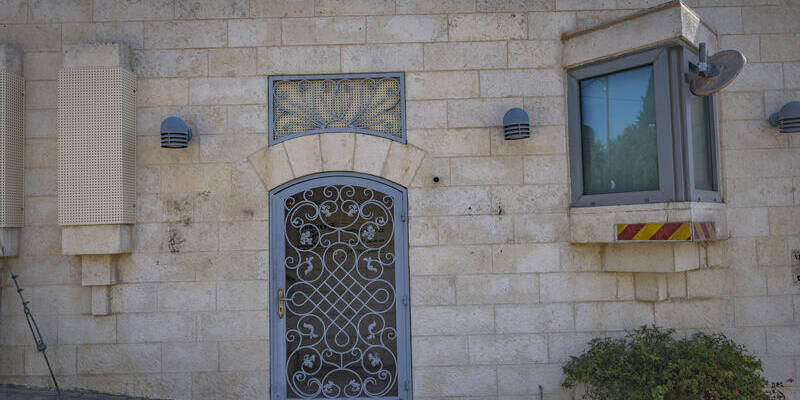
Because the consulate building is owned by the British government, Israel agreed to allow Britain to operate a seven-diplomat task force from the site, which will no longer function as a consulate.
Sa’ar said the remaining team would be permitted to operate only within a “very limited scope of activity.”
The two governments also agreed to continue diplomatic talks in which both countries will be able to raise issues of concern.
Crucially, Sa’ar said Britain agreed not to take measures against Israel in response to the implementation of the Israeli decisions.
“Alongside this, we reached understandings that serve Israeli interests,” Sa’ar said. “In accordance with the understandings we reached, no measures will be taken against Israel as a result of implementing the decisions.”
Britain had previously threatened reciprocal measures against Israeli diplomats if Israel followed through with the consulate closure.
British Foreign Secretary Ed Miliband confirmed Thursday that London would not retaliate while talks with Israel remain underway and “credible.”
Britain, however, presented the arrangement somewhat differently, announcing that the building would now be called the “UK Mission, Jerusalem” and insisting that Britain was maintaining its longstanding presence in the city.
“The UK Mission, Jerusalem is independent, operational, and will continue to deliver vital services and our work with the Palestinian people,” Miliband said.
He reiterated Britain’s position that Israel does not have the legal authority to close the consulate and that eastern Jerusalem is “occupied territory.”
Miliband also described the reduction in personnel as temporary, saying Britain had withdrawn a number of staff members and their families for security reasons and would work “in the coming months to build back up our presence.”
Sa’ar, by contrast, said Israel had authorized only the seven-member team with a “very limited” mandate.
The closure completes a series of four measures announced by Sa’ar on Sept. 8 in response to what Israel described as an escalating series of hostile moves by Britain’s Labour government.
In addition to closing the consulate, Israel removed British representatives from the International Gaza Support Center in Kiryat Gat, ended British involvement in training Palestinian Authority forces in Judea and Samaria, and barred 12 British elected officials and other British citizens accused of antisemitic or anti-Israel activity or denying Israel’s right to exist.
“All four measures in my statement from September 8 have been implemented,” Sa’ar said.
The foreign minister said Israel did not seek the confrontation and stressed that Jerusalem continues to value its relationship with Britain, including longstanding intelligence and security cooperation.
He revealed that Israel recently provided Britain with “vital information” connected to the RAF Fairford case, an apparent reference to the investigation surrounding explosives discovered near the British air base.
“We believe in dialogue and will continue to believe in dialogue,” Sa’ar said, while accusing Britain’s Labour government of failing to engage in genuine dialogue with Israel in recent years.
Sa’ar blamed the current crisis on a series of British measures since Labour took power in 2024, including recognition of a Palestinian state, renewed funding for UNRWA, restrictions on defense exports to Israel, sanctions against Israeli ministers and other Israelis, the suspension of free-trade negotiations and restrictions on military cooperation.
He also cited Britain’s latest sanctions targeting Israeli communities in Judea and Samaria and what he called “hostile rhetoric,” including accusations of “ethnic cleansing.”
Sa’ar acknowledged that further disputes between the two countries could emerge despite the new agreement.
“I cannot promise that there will not be additional crises in the future,” he said. “If there are, we will face them based on our principles.”
He concluded with a warning that Israel would no longer absorb diplomatic measures against it without responding.
“We want good relations with all the countries of the world,” Sa’ar said. “But every country that acts against Israel needs to know that there will be a price. It will not benefit from doing so, but the opposite.”
“The era of Israeli restraint is over, both on the security and diplomatic fronts.”
Do You Love Israel? Make a Donation - Show Your Support!

Donate to vital charities that help protect Israeli citizens and inspire millions around the world to support Israel too!
Now more than ever, Israel needs your help to fight and win the war -- including on the battlefield of public opinion.
Antisemitism, anti-Israel bias and boycotts are out of control. Israel's enemies are inciting terror and violence against innocent Israelis and Jews around the world. Help us fight back!
STAND WTH ISRAEL - MAKE A DONATION TODAY!