The Talmud also mentions constructing a sukkah on a camel.
By Jessica Russak-Hoffman, JNS
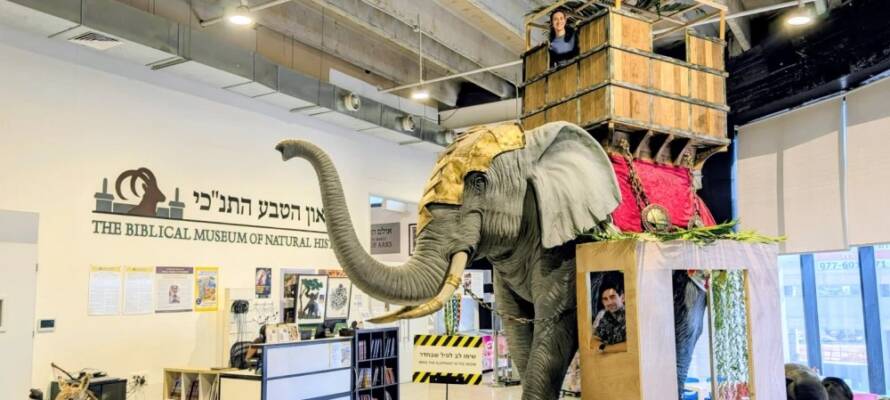
The Talmud, in tractate Sukkah, discusses constructing a sukkah, the ritual hut in which Jews live on the holiday of Tabernacles, on an elephant. The Biblical Museum of Natural History in Israel opted to bring sculptural form to that rabbinic construct.
“It’s hard to avoid talking about the elephant in the room, which is literally the elephant in the room,” Rabbi Natan Slifkin, the museum director who is known as the “zoo rabbi,” told JNS.
The life-size replica of an African elephant is on regular display in the museum and typically illustrates the Talmudic notion of the elephant being “one of the wonders of creation.”
It has also been dressed as a “Seleucid war elephant doing battle with the Maccabees,” according to Slifkin.
This year, it is also depicting part of the Sukkot holiday, which begins on Friday night.
The Talmud discusses both putting the sukkah atop an elephant and using the animal as one of the Sukkah walls.
“We did both,” Slifkin told JNS. “It was relatively straightforward for us to build one in the museum, since our elephant is not a living animal.”
To use a live elephant as a wall would be “immensely impractical,” the rabbi said.
The Talmud also mentions constructing a sukkah on a camel.
“You can build a much better sukkah on an elephant, with its broad back, than on a camel,” Slifkin told JNS.
“Why would the Mishnah mention a camel? Historically, camels were a common form of transport in the land of Israel, and people sometimes mounted framed, roofed passenger structures on top of them.”
“It was thus natural to discuss whether it would be possible to create a sukkah in such a way,” he said.
The average person was likelier to have a horse, donkey or cow than an elephant, but the large animal was also used in the discussion to illustrate what would happen if it died or collapsed, according to Slifkin.
“It would still leave you with something big enough to use as a sukkah wall,” he told JNS.
Do You Love Israel? Make a Donation - Show Your Support!

Donate to vital charities that help protect Israeli citizens and inspire millions around the world to support Israel too!
Now more than ever, Israel needs your help to fight and win the war -- including on the battlefield of public opinion.
Antisemitism, anti-Israel bias and boycotts are out of control. Israel's enemies are inciting terror and violence against innocent Israelis and Jews around the world. Help us fight back!