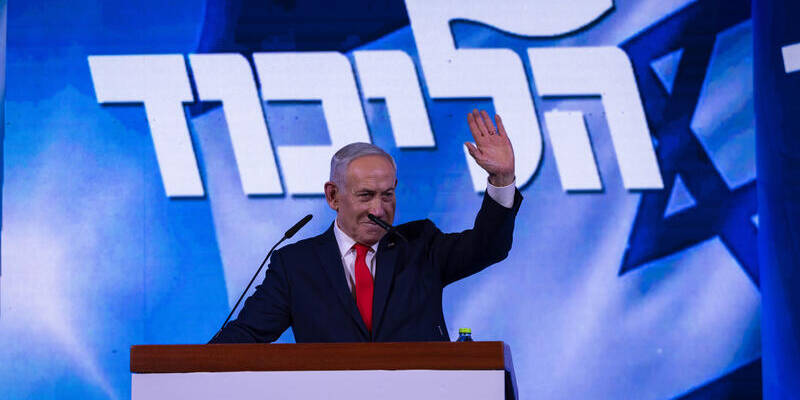
With 100% of the regular ballots counted, excluding the double-envelope votes, Netanyahu’s bloc has 53 seats, while the bloc of parties seeking to replace him, led by Gadi Eisenkot, has 48.
By United with Israel Staff
Prime Minister Benjamin Netanyahu’s right-wing bloc stands at 53 seats following the completion of the regular vote count in Israel’s national election, leaving it eight seats short of a parliamentary majority as attention turns to a record number of special ballots that could still shift the final Knesset map.
With 100% of the regular ballots counted, excluding the double-envelope votes, Netanyahu’s bloc has 53 seats, while the bloc of parties seeking to replace him, led by Gadi Eisenkot, has 48.
The Arab parties have surged to a combined 19 seats following extraordinary turnout in the Arab sector, emerging as one of the defining developments of Tuesday’s election.
The 53-48-19 breakdown leaves neither of the two main political camps with a straightforward path to the 61 seats required to form a government.
Netanyahu’s existing right-wing and religious coalition remains the larger of the two main blocs but would need eight additional lawmakers to reach a majority.
Eisenkot’s bloc faces an even larger gap. At 48 seats, it would need 13 additional lawmakers, making the position of the Arab parties potentially significant in the coalition negotiations that follow.
The completion of the regular count marks a significant change from the early hours after polls closed, when some projections suggested Netanyahu could approach or even cross the majority threshold.
Instead, as the count progressed and the exceptionally large Arab vote was incorporated, Netanyahu’s bloc settled well below 61.
The surge in Arab representation follows turnout of approximately 80% in the Arab sector, including exceptionally high participation in a number of Bedouin communities in southern Israel.
The result represents a dramatic increase from the outgoing Knesset, where Arab parties held a combined 10 seats.
The vote count, however, is not finished.
Election officials must still count approximately 600,000 double-envelope ballots, a record number representing a pool of votes equivalent in size to roughly 14 Knesset mandates.
Those ballots include votes cast by IDF soldiers and other Israelis who voted outside their regular polling stations. They will be incorporated into the national totals and could shift mandates between parties and blocs.
The Central Elections Committee has said it hopes to begin counting the double envelopes Wednesday evening, with the full count expected to be completed by Thursday afternoon.
Because the voting patterns among those casting double-envelope ballots may differ from the regular electorate, several mandates could still change hands.
Even relatively small movements could prove politically important in a Knesset where neither Netanyahu nor his opponents currently have a majority.
If the final results remain close to the current 53-48-19 division, Israel will enter a difficult period of coalition negotiations.
Netanyahu would need to find support outside his existing bloc, while Eisenkot would require either cooperation from Arab lawmakers or support from parties currently outside his camp.
A broader coalition crossing the existing political divide could also become a possibility if neither side can assemble 61 seats with its natural partners.
Once the double-envelope ballots are counted and the official results are finalized, President Isaac Herzog will consult with the factions elected to the Knesset and ask whom they recommend to form the next government. He will then assign the task to the lawmaker he believes has the best chance of assembling a coalition.
With neither bloc currently holding a majority, the focus will then shift from the ballot count to the negotiations over Israel’s next government.
Do You Love Israel? Make a Donation - Show Your Support!

Donate to vital charities that help protect Israeli citizens and inspire millions around the world to support Israel too!
Now more than ever, Israel needs your help to fight and win the war -- including on the battlefield of public opinion.
Antisemitism, anti-Israel bias and boycotts are out of control. Israel's enemies are inciting terror and violence against innocent Israelis and Jews around the world. Help us fight back!