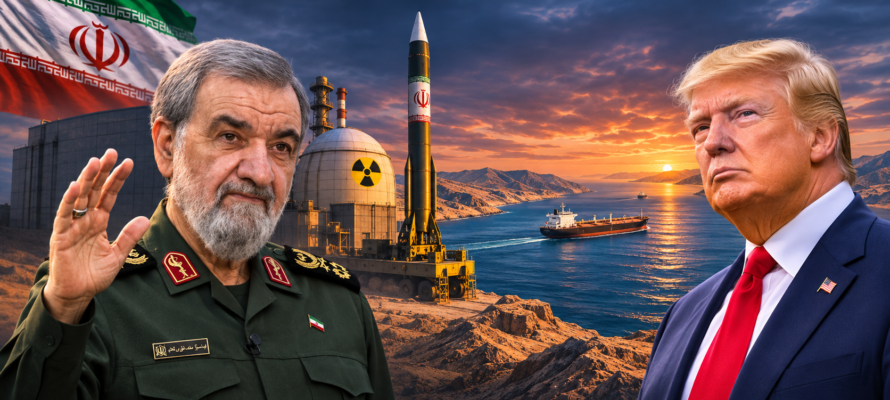
Trump’s optimistic assessment stands in sharp contrast to statements from senior Iranian officials, who have publicly rejected reports of negotiations and insisted that the United States must meet Tehran’s conditions before the war can end.
By United with Israel Staff
President Donald Trump signaled Monday that the nearly nine-month conflict with Iran could be moving toward a diplomatic resolution, citing “positive momentum” following discussions with Qatar’s prime minister, even as senior Iranian officials rejected reports of negotiations and insisted that Washington must accept Tehran’s demands.
The conflicting messages have raised fresh questions about whether Washington and Tehran are quietly moving toward an agreement, remain fundamentally divided over the terms for ending the war, or whether the diplomatic signals could be masking preparations for renewed military action.
In a lengthy Truth Social post, Trump revealed that he had held an “excellent conversation” with Qatari Prime Minister Sheikh Mohammed bin Abdulrahman Al Thani, during which the two discussed developments involving Iran.
Trump said Qatar, Saudi Arabia, the United Arab Emirates, Bahrain, Kuwait and other regional countries favored maintaining the American naval blockade of Iran, along with the newly established Operation Iron Gate targeting Iranian smuggling routes by land and sea.
“All have agreed that Iran cannot have a Nuclear Weapon — That is non-negotiable!” Trump declared.
The president also warned that the United States remains prepared to take further military action if necessary, although he suggested that renewed escalation was unlikely.
“Should there be any change with respect to developments in the Middle East, the United States of America is ‘locked and loaded’ and ready to go,” Trump wrote.
“At this point, however, that seems to be quite unlikely.”
Trump emphasized that the American military campaign had strengthened Israel’s security and reduced the Iranian threat throughout the region.
“Israel, and the entire Middle East, are protected from Iranian danger and threats,” he said.
“We are seeing positive momentum toward an end to this Conflict, and will ensure that America’s interests are at all times protected.”
The president concluded by declaring that the United States and the world would emerge from the conflict “far safer and more secure.”
However, Trump’s optimistic assessment stands in sharp contrast to statements from senior Iranian officials, who have publicly rejected reports of negotiations and insisted that the United States must meet Tehran’s conditions before the war can end.
Iranian Foreign Minister Abbas Araghchi told the state-run IRNA news agency that “the only way to end the war is to accept the Islamic Republic’s conditions.”
“The war will not end through military means or by increasing sanctions. The only solution is to use the language of respect, employ diplomacy, and comply with Iran’s demands and conditions,” Araghchi said.
He also dismissed reports of a possible meeting between US Vice President JD Vance and Mohsen Rezaei, secretary of Iran’s Supreme National Security Council, calling the speculation baseless and insisting that no such meeting was planned.
Rezaei delivered an even more confrontational message, calling on Washington to stop publishing what he described as “fake news about imaginary negotiations.”
“The time has come for America to surrender to the seven conditions that Iran has repeatedly put forward,” Rezaei wrote on X.
Iran’s demands include lifting American sanctions, ending the naval blockade, releasing frozen Iranian assets, ending the fighting on all fronts, guarantees against future attacks and compensation for damages.
The conflicting statements come amid reports that a new Pakistani-Qatari proposal has revived diplomatic discussions over Iran’s nuclear program.
Saudi news channel Al Arabiya, citing sources, reported that the Trump administration had agreed to permit Iran to enrich uranium to 3.67% on its own territory, a significant departure from Washington’s previous opposition to domestic Iranian enrichment.
Under the reported proposal, Tehran would reduce its stockpile of uranium enriched to 60% to lower concentrations, potentially with assistance from a third country, while inspectors from the International Atomic Energy Agency would be permitted to return to Iran.
The arrangement would reportedly also release between $6 billion and $9 billion in frozen Iranian funds, end the American naval blockade and reopen the Strait of Hormuz to unrestricted maritime traffic.
Those reported terms appear difficult to reconcile with Trump’s latest statement that regional governments favor continuing the blockade. The White House has not publicly confirmed the proposed concessions, and Trump made no mention of allowing Iranian uranium enrichment in his post.
The uncertainty is compounded by comments from Secretary of State Marco Rubio, who offered a considerably less optimistic assessment of the diplomatic situation on Sunday.
Speaking to reporters at Homestead Air Reserve Base in Florida, Rubio acknowledged that several countries were attempting to broker an agreement but said the efforts had produced little meaningful progress.
“I wouldn’t say we’re on the verge of a breakthrough,” Rubio said.
While emphasizing that Trump preferred a diplomatic solution, Rubio accused Tehran of making demands that were “outrageous and ridiculous and really not realistic.”
Meanwhile, Israeli Prime Minister Benjamin Netanyahu has reportedly been pressing Trump to resume major military operations against Iran rather than pursue a negotiated settlement.
According to the Financial Times, Netanyahu has urged the president to authorize additional strikes, potentially as part of a broader campaign aimed at toppling the Islamic Republic’s government.
“Netanyahu calls him every day [to urge him to resume the war],” a person briefed on the discussions told the newspaper.
The report said officials inside and outside the White House who oppose renewed military action have been attempting to counter Netanyahu’s efforts, while several regional governments continue pushing for diplomacy.
For now, the competing accounts leave the status of negotiations unclear. Trump is publicly signaling progress and suggesting that further military escalation is unlikely, while Iranian officials continue to reject reports of direct talks and demand sweeping American concessions.
Another possibility is that the apparent diplomatic momentum is serving as a smokescreen for preparations for renewed American or Israeli strikes.
Whether the conflicting signals reflect genuine movement toward an agreement, indirect negotiations through regional mediators, attempts to strengthen each side’s bargaining position or efforts to conceal military intentions remains uncertain.
What is clear is that Washington and Tehran are still publicly presenting sharply different visions of how the conflict should end, with the future of Iran’s nuclear program, American sanctions and the naval blockade remaining central points of contention.
Do You Love Israel? Make a Donation - Show Your Support!

Donate to vital charities that help protect Israeli citizens and inspire millions around the world to support Israel too!
Now more than ever, Israel needs your help to fight and win the war -- including on the battlefield of public opinion.
Antisemitism, anti-Israel bias and boycotts are out of control. Israel's enemies are inciting terror and violence against innocent Israelis and Jews around the world. Help us fight back!