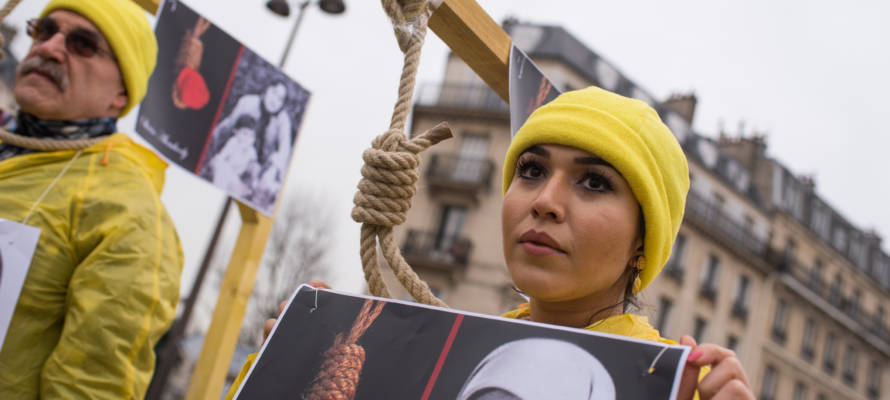
Najmeh Amini was sentenced to death for allegedly insulting the Prophet Muhammad.
By Ailin Vilches Arguello, the Algemeiner
In a stark new example of Iran’s escalating crackdown on freedom of expression, the regime has sentenced a 23-year-old woman to death for alleged blasphemy over a social media post, prompting renewed alarm among human rights groups over the country’s mounting use of capital punishment.
Najmeh Amini, an accounting student whose name has been changed for security reasons, is being held at Vakilabad Prison in the northeastern city of Mashhad after being tried and convicted in two separate cases before a Revolutionary Court and a criminal court.
According to the US-based Human Rights Activists in Iran (HRAI), Amini was sentenced to death for allegedly insulting the Prophet Muhammad after Iran’s Cyber Police, known as FATA, monitored her online activity, though the posts that supposedly led to the sentence have not been made public yet.
In a separate case, Amini received a 12-year, six-month, and one-day prison sentence on charges including threatening national security and spreading anti-regime propaganda.
Media reports indicate that Amini was arrested by security forces during the recent nationwide anti-government protests, which authorities violently crushed, leaving thousands of demonstrators tortured and killed.
In a recording attributed to Amini that circulated widely online last month, she called for international action on her case, urging the UN, legal experts, and human rights organizations to investigate her treatment by Iranian authorities.
“I do not want to make a hero out of myself today. I only want one thing: be my voice,” Amini is reportedly heard saying.
“I am an innocent young girl with so many hopes and dreams,” she continues. “I have parents who are waiting for me. A family that every night, with the fear of losing me, turns their night into morning.”
Human rights groups have warned that Iranian authorities are increasingly wielding the death penalty as a tool to instill fear, silence critics, and crush dissent, as executions and harsh prison sentences continue to draw international condemnation.
“Scores of people including dissidents and protesters remain at risk of politically motivated executions as authorities intensify repression citing ‘wartime conditions’ and national security threats, increasing the urgent need for coordinated diplomatic pressure on Iran to halt all planned executions,” Diana Eltahawy, Amnesty International’s deputy regional director for the Middle East and North Africa, said in a statement.
“Systemic impunity has emboldened Iran’s authorities to continue their assault on the right to life and other human rights, underscoring the urgent need for the referral of the situation in Iran to the International Criminal Court by the UN Security Council and the establishment of an international criminal justice mechanism for Iran through the UN General Assembly,” she continued.
According to the Oslo-based group Iran Human Rights (IHRNGO), Iran has carried out more than 600 executions so far this year, raising alarm over the growing use of capital punishment amid a broader crackdown on dissent and political opposition.
IHRNGO’s director, Mahmood Amiry-Moghaddam, has warned that Iranian authorities are testing the international community’s “tolerance” for executions, raising concerns that a failure to respond could embolden Tehran to impose the death penalty in an even wider range of cases.
“Sentencing a young woman to death for what she posted on social media risks normalizing the use of the death penalty against peaceful expression and pushing the boundaries of the death penalty even further,” Amiry-Moghaddam said in a statement.
“If the international community does not respond firmly now, cases like this could become far more common,” he continued.
Iranian law makes insulting the Prophet Muhammad or revered Shia figures a capital offense, though certain circumstances, including intoxication or a lack of deliberate intent, may exempt defendants from the death penalty while leaving them vulnerable to other punishments, including up to 74 lashes.
During her defense at trial, Amini reportedly told the court that she had published the remarks while experiencing hallucinations after taking psychedelic mushrooms with friends, arguing that she had not acted with deliberate intent.
However, the presiding judge rejected Amini’s defense, according to the Iranian newspaper Khorasan, dismissing her account of having acted under the influence of hallucinations.
“Why, in that same hallucinatory state, did you not insult other individuals or opponents of the regime, such as America and Israel? Or how, while under the influence of hallucinations, were you deliberate enough to know exactly which channel or social network to publish an offensive post in?” the judge reportedly asked her.
Amini’s death sentence remains subject to appeal, with Iran’s Supreme Court yet to issue a final ruling.
As in past years, executions remain one of the starkest manifestations of human rights abuses in Iran, with at least 2,488 people executed last year, including 63 women and two children, 13 of them carried out publicly, according to a recent report by the Human Rights Activists News Agency (HRANA).
HRANA’s Statistics and Documentation Center also found that 78,907 people were arrested on ideological or political grounds from March 2025 to March 2026, highlighting a pervasive climate of repression across the country.
Yet, the report warns that the number of arrests is likely much higher, given the difficulty of tracking such cases — especially earlier this year during the country’s nationwide uprising against the regime.
HRANA’s report found that at least 6,724 protesters, including 236 children, were killed during these protests, with an additional 11,744 cases still under verification. Multiple reports have put the death toll at over 30,000.
Several other accounts have also indicated that Iranian security forces routinely use torture and coercion to extract forced confessions while denying detainees access to lawyers.
Courts also frequently rely on the Islamic Penal Code’s principle of elm-e-qazi, which allows judges to determine guilt based on their own assessment of circumstantial evidence, a practice critics say is applied arbitrarily.
Do You Love Israel? Make a Donation - Show Your Support!

Donate to vital charities that help protect Israeli citizens and inspire millions around the world to support Israel too!
Now more than ever, Israel needs your help to fight and win the war -- including on the battlefield of public opinion.
Antisemitism, anti-Israel bias and boycotts are out of control. Israel's enemies are inciting terror and violence against innocent Israelis and Jews around the world. Help us fight back!