The statement revealed the creation of a deconfliction mechanism involving the parties and the Lebanese government to support implementation of the cessation of military operations outlined in the memorandum of understanding.
By United with Israel Staff
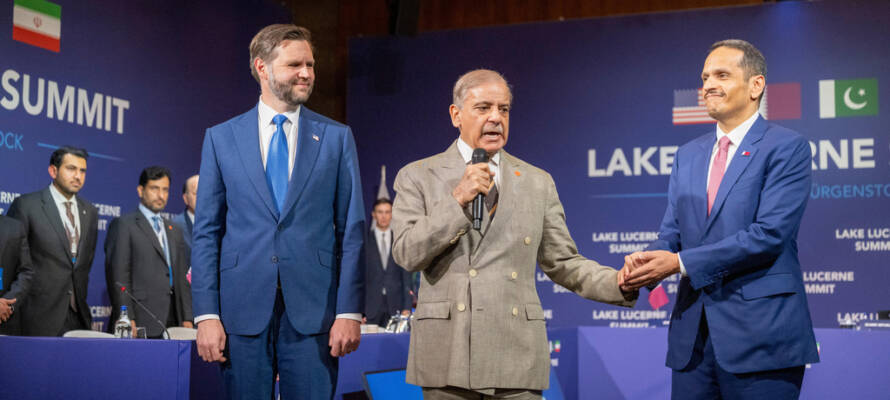
Nuclear negotiations between the United States and Iran concluded early Monday morning in Switzerland after roughly 18 hours of talks that at one point appeared on the verge of collapse, with mediators Qatar and Pakistan announcing progress and a new framework aimed at reaching a comprehensive agreement within 60 days.
The talks, held near Lake Lucerne, brought together U.S. Vice President JD Vance, Iranian Foreign Minister Abbas Araghchi, Pakistani Prime Minister Shehbaz Sharif, Qatari Prime Minister Sheikh Tamim bin Hamad Al Thani, and other senior officials.
Discussions focused on Iran’s nuclear program, sanctions relief, frozen Iranian assets, security in the Strait of Hormuz, and implementation of the recently announced ceasefire in Lebanon.
The summit nearly unraveled on Sunday after the Iranian delegation walked out in protest over remarks made by President Donald Trump.
Speaking as the talks opened, Trump said he held “all the cards” and warned that Iran would face severe consequences if it attempted to close the Strait of Hormuz. Iranian officials reportedly argued the comments violated the memorandum of understanding governing the negotiations and temporarily suspended their participation.
For several hours, it was unclear whether the Iranian delegation would return. Iranian sources suggested the future of the summit was in doubt, but after consultations involving Qatari and Pakistani mediators, the talks resumed and continued Sunday night.
In a joint statement released after the summit, Qatar and Pakistan described the discussions as taking place in a “positive and constructive atmosphere” and said “encouraging progress” had been achieved.
The statement announced the creation of a High-Level Committee that will provide political oversight for the negotiations moving forward. Chief negotiators will report regularly to the committee, while specialized working groups will focus on nuclear issues, sanctions, monitoring mechanisms, and dispute resolution.
The parties also agreed on a roadmap aimed at reaching a final agreement within 60 days. The statement said the understandings reached at Lake Lucerne would serve as the foundation for the immediate launch of technical negotiations, which are expected to continue throughout the week in Switzerland.
A significant developments was the establishment of a direct communication channel between the parties designed to prevent incidents and miscommunication in the Strait of Hormuz. According to the statement, the mechanism is intended to help ensure the safe passage of commercial vessels through the strategic waterway, which has been a major source of tension in recent weeks.
The statement also revealed the creation of a deconfliction mechanism involving the parties and the Lebanese government to support implementation of the cessation of military operations outlined in the memorandum of understanding. The mechanism is intended to reduce the risk of renewed fighting and address violations before they escalate into a broader conflict.
The Lebanon component of the talks comes at a particularly sensitive moment. Despite the ceasefire, Hezbollah attacks over the weekend killed five Israeli soldiers in southern Lebanon, underscoring the fragility of the arrangement and raising concerns in Jerusalem about Hezbollah’s continued military activity near the border.
At the same time, Israel and Lebanon are preparing for a new round of U.S.-mediated talks in Washington on Tuesday. While Prime Minister Benjamin Netanyahu and Defense Minister Israel Katz have repeatedly insisted that Israel will not withdraw from the security zone established in southern Lebanon, Israeli officials acknowledged Sunday that limited troop redeployments from selected positions are being examined ahead of the negotiations.
According to officials familiar with the discussions, the United States has not requested an Israeli withdrawal, but Israeli decision-makers are considering whether selective redeployments could be presented as an Israeli initiative. Among the locations reportedly under review is the strategic Beaufort Castle area, where Israeli forces have carried out extensive operations in recent weeks.
Qatar and Pakistan praised both Washington and Tehran for their continued commitment to diplomacy and pledged to continue facilitating negotiations. The mediators also thanked what they described as “brotherly and friendly countries” for supporting the process.
Do You Love Israel? Make a Donation - Show Your Support!

Donate to vital charities that help protect Israeli citizens and inspire millions around the world to support Israel too!
Now more than ever, Israel needs your help to fight and win the war -- including on the battlefield of public opinion.
Antisemitism, anti-Israel bias and boycotts are out of control. Israel's enemies are inciting terror and violence against innocent Israelis and Jews around the world. Help us fight back!